⚡ Executive Summary: The Zero-Loss Mandap Standard
There is no retake when the groom applies Sindoor or when the bride showers rose petals on the Mandap stage. In high-stakes Indian weddings spanning 14 to 18 continuous hours, memory card corruption, write-buffer throttling, and heat-induced card lockups represent the single greatest existential risk to a photography studio's brand. This masterclass unpacks the definitive dual-card recording architecture, dissects real-world buffer limitations between UHS-II V60/V90 SD and CFexpress Type A/B media, and outlines the battlefield-tested 3-2-1 on-site backup protocol used by elite Indian studios to eliminate file loss forever.
💾 The Nightmare Scenario: Why Single-Card Shooting is Professional Russian Roulette at Indian Weddings
Every experienced wedding photographer in India either has a horror story or personally knows a colleague who lived through one: coming home from a lavish 3-day destination wedding in Udaipur or a chaotic 1,200-guest reception in Kolkata, inserting an SD card into a card reader, and seeing the dreaded system alert: "The disk you inserted was not readable by this computer. Initialize / Ignore / Eject."
Unlike commercial studio portraits or pre-wedding couple shoots where a missing frame can theoretically be rescheduled, an Indian wedding is a fast-paced, emotionally charged whirlwind of unrepeatable rituals. Once the Kanyadaan or Sindoor Daan concludes, that sacred moment belongs to history. If your primary card fails due to static shock from heavy silk lehengas, voltage spikes from third-party dummy batteries, or physical contact wear, your entire studio reputation—and potentially your business solvency—is on the line.
Modern flagship cameras (such as the Sony A7 IV, Sony A9 III, Canon EOS R6 Mark II, and Nikon Z8) feature dual card slots precisely to engineer redundancy into every shutter actuation. Yet, an alarming number of studio operators configure their cameras in Sequential Mode (overflow) or shoot JPEG to the second slot to save money on memory cards. This is a critical strategic blunder.
Setting your secondary memory slot to "Overflow" or "Relay" provides ZERO data redundancy. If Slot 1 corrupts halfway through the ceremony, every single photo taken up to that point is wiped out. Elite studios mandate simultaneous RAW+RAW backup recording across both slots from the moment the camera is powered on at Haldi until the final Bidai.
⚡ Buffer Freezes & Burst Stalls: Why Your Camera Locks Up During Sindoor Daan & Varmala
Have you ever held down the shutter during an explosive Jaimala flower blast or high-energy Baraat dance, only to watch your viewfinder freeze, the green write LED stay solid red, and your camera completely refuse to take another picture for 8 agonizing seconds? That terrifying phenomenon is known as Buffer Exhaustion.
When you capture uncompressed 33MP or 45MP RAW files at 10 to 20 frames per second, your camera's internal high-speed DRAM buffer fills up in less than 3 seconds. Once the buffer is full, the camera's frame rate drops immediately to the sustained write speed of the slowest card installed in your slots:
- The Lowest Common Denominator Principle: When recording in redundant RAW+RAW mode, your camera can only write as fast as its slowest card. If Slot 1 holds a blazing-fast 800 MB/s CFexpress card and Slot 2 holds an entry-level 90 MB/s UHS-I V30 card, your camera's buffer pipeline is throttled down to 90 MB/s.
- Thermal Throttling in Hot Mandaps: In traditional open-fire Mandap environments, ambient temperatures easily exceed 42°C. Budget plastic SD cards trapped inside sealed camera doors overheat rapidly, triggering internal safety throttling that slashes write throughput by up to 50%.
- Corrupted File Allocation Tables (FAT): If a photographer turns off the camera or hot-swaps a card while the buffer LED is actively clearing, the file directory is severed, resulting in "RAW format unrecognized" errors in Lightroom.
Never mix card performance tiers. For cameras with dual SD slots (e.g. Sony A7 III/IV, Canon R6 II), install matched pairs of UHS-II V90 cards (like SanDisk Extreme Pro 300MB/s, Sony TOUGH M-Series, or ProGrade Digital Cobalt). For hybrid CFexpress/SD bodies (Sony A1, A7S III, Nikon Z8), format both media in-camera before every major event session.
🔍 V60 vs V90 vs CFexpress Type A & B: The Real-World Speed Test Indian Studios Need
Memory card manufacturers advertise maximum "read" speeds on their packaging (e.g. "Up to 300 MB/s"), but for burst photography and 4K60p wedding video, only sustained minimum write speed matters. Here is how modern storage standards perform under the relentless stress of an Indian wedding timeline:
While CFexpress offers infinite buffer clearing, paired V90 UHS-II cards provide the optimal balance between high-speed write reliability, thermal resistance, and cost efficiency across multi-cam studio crews. Investing in four 128GB V90 cards costs less than a single client dispute over lost ritual footage.
🛡️ The 3-2-1 On-Site Field Backup Workflow: How Top Teams Secure 8,000 RAWs Before Leaving the Venue
Shooting to dual cards protects you during the shoot. But what happens during the midnight journey back from the venue? What if a camera bag is misplaced at the hotel lobby, or a hard drive suffers a mechanical head crash in the taxi?
Industry-leading Indian wedding studios enforce the 3-2-1 On-Site Redundancy Rule before their team packs up equipment:
- 3 Total Copies: Maintain at least three copies of all RAW footage.
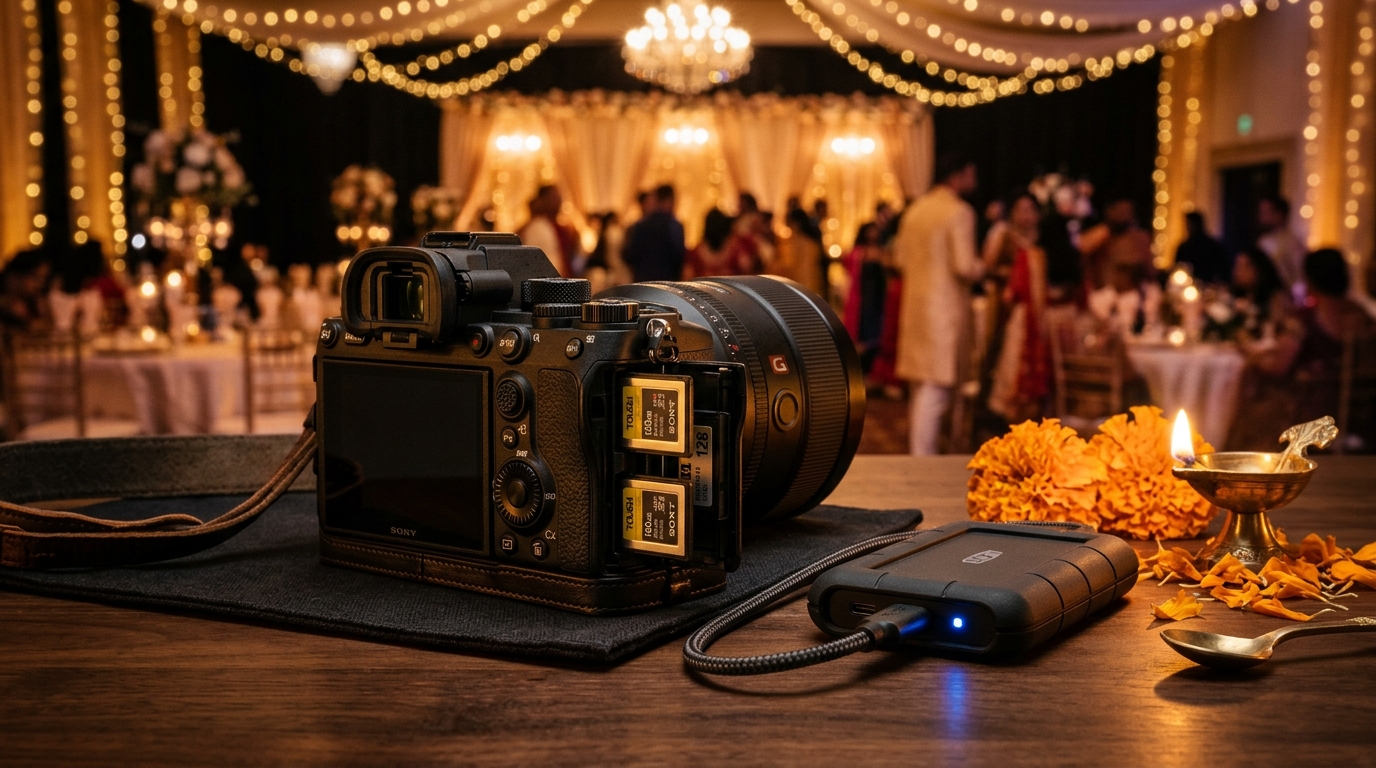
- 2 Different Media Types: Store data across distinct physical media (e.g. Master SD cards + Rugged NVMe SSD).
- 1 Off-Site / Physical Separation: The camera cards and the backup SSD must travel in separate bags with different team members. If the lead cinematographer's pelican case is stolen, the second shooter still carries the complete wedding archive on an encrypted solid-state drive.
To implement this efficiently in noisy banquet greenrooms without carrying cumbersome laptops and power cords, top teams deploy compact portable NVMe hubs or rugged tablets with USB 3.2 Gen 2 (10 Gbps) bus power. In under 18 minutes, 256GB of high-resolution RAW footage is duplicated with cryptographic checksum verification (MD5/SHA256) to guarantee bit-for-bit fidelity.
🚀 From Raw Backups to Client Proofing: The Pixelect 1-Click Auto-Copy Pipeline
Once your 8,000 RAW files are safely backed up on dual drives, your next bottleneck begins: How do you get the bride and groom to select 250 album photos quickly without Google Drive lag, USB courier delays, or weeks of client ghosting?
In the traditional manual workflow, studios waste hours exporting low-res JPEGs, uploading hundreds of gigabytes to slow cloud drives, and manually reading messy WhatsApp message lists or handwritten image numbers (e.g. "DSC_0412.JPG, DSC_0415.JPG, please remove uncle from background"). Then, a retoucher must sit for an entire afternoon manually searching and copying those specific 250 RAW files out of an 8,000-photo folder.
With Pixelect SmartSelection, you upload lightweight compressed previews to a branded client portal in minutes. Your clients enjoy an ultra-fast, mobile-optimized experience with built-in PIN security. When the couple hits "Submit Selection", Pixelect generates an automated batch script or direct desktop bridge that scans your local hard drive, identifies the exact selected master RAW files, and copies them into a dedicated /Selected_RAWs folder in just 15 seconds. Zero manual searching. Zero missed files.
📋 The 4-Step Bulletproof Data Integrity Checklist for Wedding Shoots
Always format both cards inside the camera body they will be used in. Confirm the display screen shows [RAW+RAW] or [Simult. Rec] icon before the bride enters makeup.
Ensure both cards share the exact same sustained write speed class (preferably V90 UHS-II or VPG200 CFexpress) to eliminate buffer bottlenecks during ritual bursts.
At the end of each major session (Sangeet / Mandap), offload Card A to a rugged SSD with MD5 hash verification. Leave Card B untouched inside the card case as physical redundancy.
Publish client selection galleries via Pixelect within 48 hours of shoot wrap. Use 1-Click Local RAW Auto-Copy to begin retouching without touching manual search filters.
❓ Frequently Asked Questions (FAQs)
Q1: Can I shoot RAW to Slot 1 and high-res JPEG to Slot 2 to save storage?
While this is technically possible, professional studios strongly discourage it for wedding master coverage. JPEGs have only 8-bit color depth and heavily compressed dynamic range. If Slot 1 corrupts during a high-contrast Mandap fire ritual, recovering shadow details on a groom's black sherwani or highlight blowouts on bridal gold jewelry from an 8-bit JPEG will severely compromise your album quality. True redundancy requires dual RAW.
Q2: How often should Indian wedding studios retire their SD and CFexpress cards?
Memory card flash memory cells degrade with continuous write-erase cycles and high heat exposure. For active Indian wedding photographers shooting 30 to 45 multi-day weddings annually, cards should be retired to secondary/backup duty after 18 to 24 months of heavy usage, or immediately if the card shows any erratic write pauses or read delays in testing.
Q3: How does Pixelect's 1-Click Local RAW Auto-Copy work without uploading massive files?
Pixelect operates on an intelligent hybrid model. You upload lightweight web-optimized preview files to the client's WhatsApp PIN gallery. When your client hearts and approves their favorite 250 photos, Pixelect exports an automated selection recipe. Through the lightweight Pixelect desktop companion, it matches file IDs against your original local hard drive folder and copies only the matching high-res RAW files into an edit-ready folder in approximately 15 seconds.
Stop Losing Hours to Manual RAW File Hunting
Deliver beautiful, PIN-protected WhatsApp galleries in minutes. Let clients approve selections in under 48 hours and auto-copy their chosen RAWs from your local drives in 15 seconds flat.
Start Free with Pixelect SmartSelection →Zero credit card required • Built specifically for Indian wedding studios