📋 Executive Summary: The 120-Second Varmala Challenge
The Varmala (Jaimala) ceremony is the undisputed cinematic crescendo of an Indian wedding. In fewer than two minutes, photographers face revolving hydraulic stages, blinding 5600K cold pyro fountains, dense low-lying dry-ice clouds, and explosive confetti cannons. This masterclass unpacks the exact dual-camera focal distribution, manual flash-to-ambient balance ratios, and autofocus obstruction bypass techniques used by India's top wedding studios to guarantee razor-sharp focus and zero highlight clipping on royal bridal lehengas.
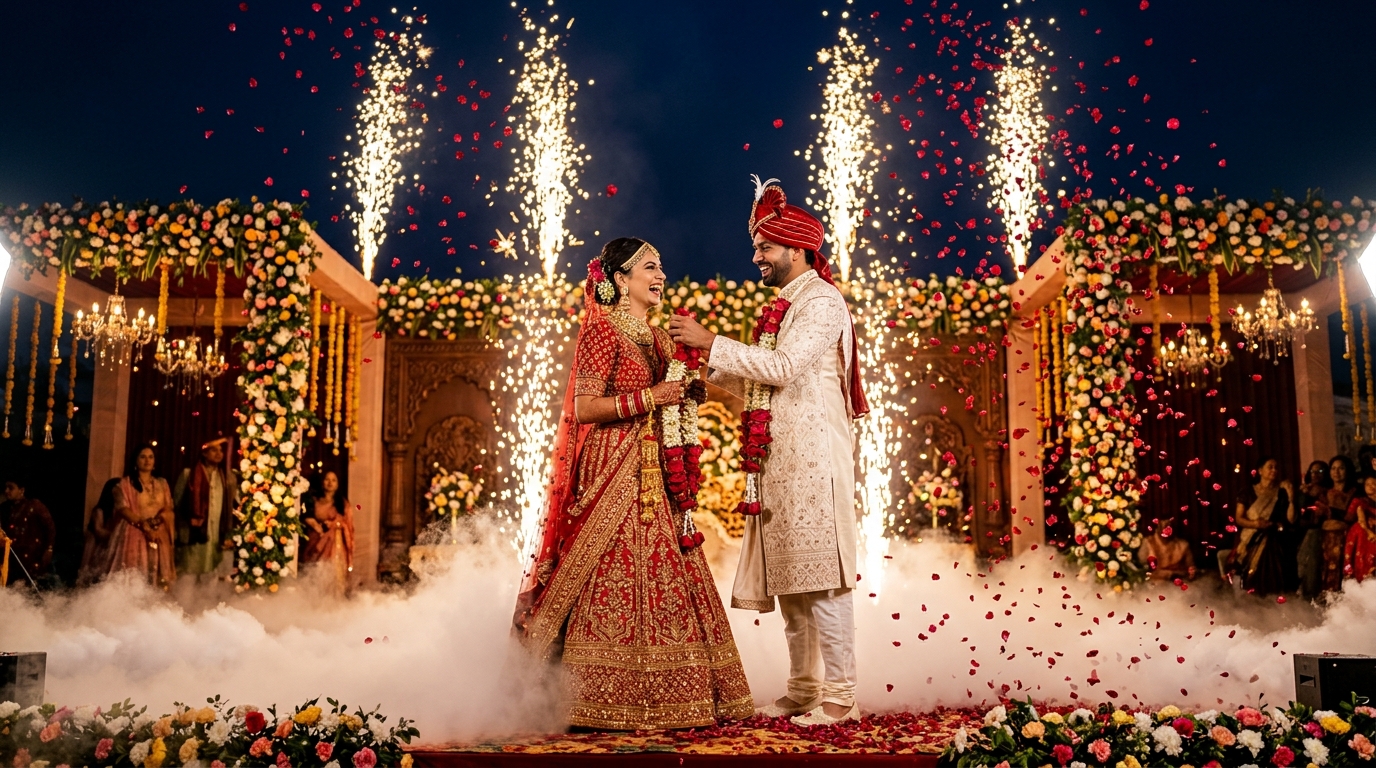
Every Indian wedding photographer knows the sudden spike in heart rate when the DJ announces the Varmala. The lights in the banquet or lawn dim to near-pitch darkness. The couple steps onto a motorized, rotating hydraulic stage. Suddenly, four to eight cold pyro sparkular fountains shoot 12-foot golden fountains into the night sky, dry-ice fog machines erupt with thick opaque white clouds, and heavy brass air-cannons fire thousands of crimson rose petals and metallic confetti into the air.
You have exactly 90 to 120 seconds. There are no retakes, no pauses, and no second chances. If your camera autofocus hunts into the dense fog, or if your exposure blows the bride's crimson velvet Sabyasachi lehenga into a featureless pink blob, that hero album cover spread is lost forever. Here is the field-tested tactical blueprint used by India’s elite photography teams to capture immaculate, magazine-grade Varmala photographs consistently on every single wedding.
🔥 1. The Anatomy of a Modern Varmala: Navigating 12+ Stops of Extreme Dynamic Range
The core challenge of Varmala photography is not simply the speed of the action; it is the extreme dynamic range disparity occurring across fractions of a second. Consider the elements coexisting in a single frame:
- Cold Pyro Sparkulars: These titanium-zirconium granular fountains emit intense, concentrated light with a color temperature hovering around 5200K–5600K, measuring upwards of EV 14 to EV 15 at the plume base.
- Background LED Screens: Emitting high-contrast digital graphics, often running at refresh frequencies (PWM) that can introduce banding, measuring around EV 9 to EV 11.
- Ambient Night Lawn or Banquet Darkness: Deep shadow backgrounds registering as low as EV 1 to EV 3.
- Intricate Bridal Attire: Gold zardozi embroidery, polki diamond sets, and dark crimson velvet lehengas requiring delicate highlight and mid-tone preservation without crushing shadow detail.
When you rely on automatic or semi-automatic exposure (Aperture Priority or Program mode), your camera’s evaluative matrix metering will fail catastrophically. The instant the cold pyro fountains erupt, the metering sensor detects an overwhelming flood of luminance, instantly underexposing the bride and groom’s faces by 3 to 4 stops. Conversely, if you meter strictly for the couple’s faces before the pyro ignites, the fireworks explode into pure, unrecoverable #FFFFFF digital clipping.
📸 2. Dual-Body Lens & Stance Strategy: 24-70mm f/2.8 & 85mm / 70-200mm Synergy
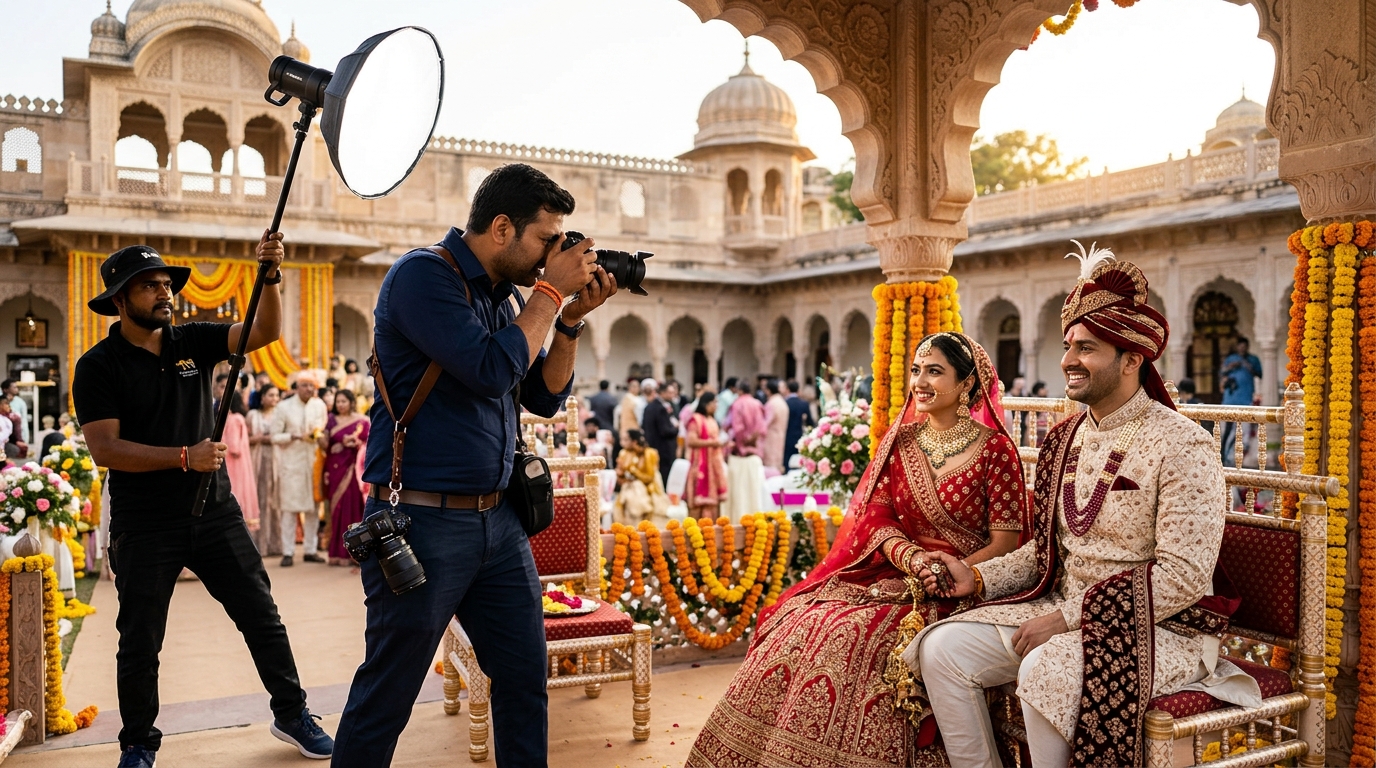
One photographer cannot capture the grandeur of a hydraulic Varmala stage and the intimate micro-expressions of the couple simultaneously. Top wedding studios operate a synchronized two-shooter protocol with distinct focal allocations:
| Camera Operator | Focal Length & Lens | Position & Stance | Primary Shot Objective |
|---|---|---|---|
| Lead Shooter (Camera A) | 24-70mm f/2.8 GM II or 35mm f/1.4 Prime | Center-stage axis, low-angle chest crouch (8–12 feet away) | Grand environmental establishing shot: fireworks plume, rotating stage architecture, falling flower showers, and crowd silhouette. |
| Second Shooter (Camera B) | 70-200mm f/2.8 or 85mm f/1.4 / 135mm f/1.8 | 45-degree flank, elevated on a 2-step folding aluminum stool (15–20 feet away) | Emotional micro-expressions: bride’s laughter, groom dodging the garland, emotional glances of parents standing at the stage perimeter. |
Notice the elevation requirement for Camera B. In 95% of North and South Indian weddings, the moment the couple begins exchanging garlands, immediate family members, bridesmaids, and event planners surge toward the base of the stage holding smartphones. If your second shooter is standing at eye-level on the ground, their line of sight will be obstructed by raised elbows and phone screens. Standing 1.5 feet higher on a lightweight aluminum step stool completely clears the crowd's heads.
💡 3. Off-Camera Flash vs. Cold Pyro: Balancing 5600K Sparkulars & Ambient Glow
Direct on-camera speedlight flash is the quickest way to ruin a Varmala image. It creates harsh, flat lighting, casts distracting hard shadows onto the stage backdrop, turns the swirling dry-ice fog into a blinding white opaque wall, and washes out the natural golden luminescence of the fireworks.
Instead, elite studios deploy a 2-Point Cross-Lighting Wireless Flash Grid using compact portable strobes (such as Godox AD200 Pro II, AD300 Pro, or Profoto B10X):
Light 1: The High-Angle Rim / Hair Separator (Backlight)
- Position: Placed 10–12 feet behind the couple, elevated to 8.5 feet on an air-cushioned light stand or clamped to the rear stage trussing.
- Angle: Aimed down at a 45-degree angle toward the back of the bride and groom’s heads and shoulders.
- Modifier: Bare bulb with a standard 7-inch reflector and 30-degree honeycomb grid, or a Godox V1 Pro with magnetic dome.
- Power & Color: Set to manual 1/16th power. Fit a 1/4 CTO (Color Temperature Orange) gel to match the warm golden glow of the sparkular fountains.
- Purpose: This light creates a razor-sharp halo rim around the couple's silhouettes, visually separating them from the dark banquet background, while making every floating rose petal and champagne droplet sparkle like suspended diamonds.
Light 2: The Off-Axis Key Fill (Front Light)
- Position: Placed 45 degrees to the left or right of the lead photographer, 10–14 feet from the center of the stage, elevated to 7.5 feet.
- Modifier: 65cm or 85cm quick-open parabolic softbox with front diffusion and fabric grid to prevent light spill onto the floor.
- Power: Manual 1/32th to 1/16th power (providing a crisp f/4.0 exposure on the couple’s faces at ISO 800).
- Purpose: Soft, flattering directional light that fills eye sockets, emphasizes facial contours, and keeps skin tones rich, creamy, and natural without flattening bridal makeup.
🌫️ 4. Conquering Dense Dry-Ice Smoke & Confetti Blasts: Camera AF Lock Secrets
Modern mirrorless autofocus systems from Sony (Real-Time Eye AF), Canon (Dual Pixel CMOS AF II), and Nikon (3D Tracking) are optical marvels, but heavy dry-ice fog and falling rose petals are their kryptonite. When dense white vapor rolls across the stage and hundreds of fluttering red petals pass within inches of the lens, standard wide-area autofocus will frantically jump from the bride's eye to a floating petal, resulting in back-focused, soft portraits.
To lock impenetrable focus under these hostile conditions, program your custom camera buttons with these field-tested autofocus parameters:
- AF Tracking Sensitivity (Sticky Tracking): Set your AF Subject Shift Sensitivity / Tracking Sensitivity to Level 1 (Locked On / Low). This tells the camera algorithm: "Once locked onto the bride's face, do NOT switch to temporary obstacles (such as petals or smoke clouds) that pass in front of the frame."
- Focus Area Selection: Do not use Wide or All-Point Area. Switch to Tracking: Expand Flexible Spot (Sony), Spot AF / Point AF (Canon), or Custom Wide-Area (Nikon). Place the initial target point directly over the bride’s bindi or forehead jewelry.
- Pre-Focus Manual Lock Routine: While the couple is walking up the stage stairs—before the smoke machines are triggered—pre-focus on the groom’s sherwani buttons. If the smoke becomes completely impenetrable (zero contrast for phase detection), hold down your AF-ON button locked at that pre-set distance.
⚙️ 5. Hydraulic & Revolving Stages: Shutter Speed, Tracking & Kinetic Composition
Grand Indian weddings frequently incorporate rotating circular stages or scissor-lift hydraulic platforms that elevate the couple 10 to 15 feet into the air. This adds two dangerous variables: rotational velocity and vertical elevation change.
If the stage is rotating at 4 to 6 revolutions per minute, shooting at 1/160s or 1/200s will produce subtle motion blur along the edges of the spinning lehenga and floral garlands. To freeze both the rotational movement and the fluttering petals crisply in mid-air:
- Minimum Shutter Speed: Maintain a strict baseline of 1/400s to 1/500s. If your flash does not support High-Speed Sync (HSS) at that shutter speed, you will need to push your strobe power and ensure your wireless trigger supports high-speed transceiver sync.
- Aperture Sweet Spot: Resist the temptation to shoot wide open at f/1.4 or f/1.8. When the couple is rotating, their planes of focus diverge constantly; at f/1.4, the bride will be razor-sharp while the groom just 18 inches behind her is completely out of focus. Stop down to f/2.8 or f/4.0 to ensure both faces sit safely within the depth-of-field envelope.
- ISO Flexibility: Set your camera to a fixed ISO between 800 and 1600. Modern full-frame sensors (Sony A7 IV, Canon R6 Mark II, Nikon Z8) exhibit virtually zero objectionable noise at ISO 1200, giving you the dynamic headroom needed to capture both shadow detail and highlight sparkle.
⚡ 6. Post-Ceremony RAW Overload: Culling 1,500 High-Speed Bursts in Record Time
Because the Varmala sequence unfolds at breakneck speed, both shooters typically fire continuous high-speed bursts (10 to 20 frames per second). In just 90 seconds, a two-shooter team will generate between 1,200 and 2,500 uncompressed RAW files for this single sequence alone.
The traditional studio workflow quickly grinds to a halt here. Photographers manually import thousands of massive RAWs into Lightroom, spend hours waiting for smart previews to generate, click through hundreds of nearly identical burst shots to find open eyes, and then struggle to get the couple to pick their favorite stage photos for the wedding album.
✅ 4-Step Actionable Checklist for Flawless Varmala Coverage
✅ Meet the stage pyrotechnician and DJ 30 minutes prior. Confirm exact pyro trigger cues, flame heights, fog machine angles, and platform rotation speeds.
✅ Set cameras to 1/400s, f/3.2, ISO 1000. Set rear rim strobe to 1/16th with 1/4 CTO gel; front key softbox to 1/32th power. Test fire on a stand-in assistant.
✅ Set AF tracking sensitivity to "Locked On (1)". Cam A takes center low-angle with 24-70mm; Cam B mounts folding step stool with 70-200mm at 45 degrees.
✅ Deliver curated web-optimized proofs to the couple via WhatsApp PIN gallery within 48 hours; use Pixelect 1-Click Local RAW Auto-Copy to isolate album finals in 15 seconds.
❓ Frequently Asked Questions (FAQs)
Q1: Can we shoot Varmala without off-camera flash if the banquet provides heavy stage follow-spots?
Relying exclusively on venue follow-spots is extremely dangerous. Venue follow-spots are usually non-calibrated 7000K industrial LEDs or aging halogens with severe green/magenta spikes and low CRI (<75). When the cold pyro fires, these spotlights create unflattering downward raccoon eyes and leave the groom's face in harsh shadow. A dedicated off-camera key light ensures studio-grade skin tone fidelity and consistent 95+ CRI quality.
Q2: What is the single best lens if I only have one photographer on stage?
If you are shooting solo, a fast 24-70mm f/2.8 zoom lens is mandatory. At 24mm, you can capture the grand perspective of the entire stage, pyro fountains, and flower showers. A quick zoom to 70mm allows you to capture tight chest-up portraits of the couple smiling as the garlands touch their shoulders, without physically moving and fighting through the surrounding family members.
Q3: How do we prevent cold pyro spark dust from damaging our camera sensors during lens changes?
Never change lenses near the stage during or immediately after the Varmala. The micro-particulate powder remains suspended in the air for up to 15 minutes after the sparkulars stop. If you change a lens on stage, electrostatic sensor attraction will pull these particles straight onto your low-pass filter or sensor glass. If a lens change is unavoidable, walk at least 30 feet away into an enclosed green room or production tent.