📋 Executive Summary: Mastering the Indian Midday Sun
Every Indian wedding photographer encounters the dreaded 12:00 PM outdoor Muhurat or midday Haldi pool party. The scorching Indian sun beats down relentlessly, casting unflattering raccoon shadows under the couple's eyes, burning out pure silk lehenga highlights to clipping white, and turning rich Indian skin tones into harsh, contrasted textures. Conventional wisdom tells you to hide under shady trees or stop down your aperture to f/11—destroying your creamy portrait bokeh. In this comprehensive 2026 technical masterclass, we break down the exact physics, mobile battery strobe rigs (Godox AD200 Pro II & AD300 Pro), camera shutter mechanics, and color calibration secrets behind High-Speed Sync (HSS). Learn how top Indian luxury studios turn blistering midday glare into editorial, three-dimensional magazine covers at 1/8000s and f/1.4.
☀️ 1. The Midday Indian Wedding Dilemma: When the Sun Is Your Fiercest Competitor
Whether you are shooting a royal destination wedding at an Udaipur heritage palace, an open lawn Baraat in Delhi during peak summer, or a seaside Mandap in Goa, Indian wedding schedules rarely respect the photographer's beloved "Golden Hour." Muhurat timings are determined by planetary alignments and family priests, not soft ambient light. As a result, lead photographers frequently find themselves facing the harshest lighting scenario possible: direct, vertical sunlight between 11:30 AM and 2:30 PM, registering over 85,000 to 100,000 Lux.
When shooting under these conditions with natural light alone, you face an unforgiving optical compromise:
- Severe Eye Socket & Nose Shadows: Direct overhead sunlight casts dark triangular shadows under brow ridges, beneath noses, and across necklines, instantly aging the bride and groom.
- Blown Zari & Embroidery Highlights: High-end designer lehengas (Sabyasachi, Manish Malhotra, Raw Mango) feature intricate gold and silver threadwork. Exposing for the couple's faces completely blows out this metallic detail into unrecoverable 255-white clipping.
- Loss of Background Separation: To avoid overexposure at native shutter speeds without flash, photographers are forced to stop down their lenses to f/8, f/11, or f/16. While exposure is balanced, background palace architecture, noisy tourist crowds, and chaotic tents snap into pin-sharp focus, destroying the cinematic subject isolation couples expect.
- Squinting & Eye Strain: Asking couples to look toward the ambient light results in constant squinting, watery mascara, and stiff, unnatural expressions.
Mounting a 60Ws or 76Ws on-camera flash (like a Godox V1 or Canon 600EX-RT) and switching it to HSS at 1/4000s will fail outdoors. Because HSS converts the single flash burst into thousands of stroboscopic micro-pulses, effective power output drops by 70% to 85%. At distances beyond 1.5 meters, standard speedlights produce virtually zero visible fill against 100,000-lux Indian sunlight, resulting in dead batteries and overheated flash heads within 15 frames.
⚡ 2. Demystifying High-Speed Sync (HSS): Physics, Sync Speeds & Shutter Slits
To master outdoor lighting, every lead photographer must understand the mechanical operation of the focal-plane shutter inside modern mirrorless cameras (Sony A7 IV, Sony A9 III, Canon R6 Mark II, Nikon Z8).
Every camera sensor features two shutter curtains—a front curtain and a rear curtain. At or below your camera's Native X-Sync Speed (typically 1/200s or 1/250s), the sequence occurs as follows:
- The front curtain opens completely, exposing 100% of the sensor surface.
- The strobe fires a single, instantaneous burst of light (lasting between 1/1,000s and 1/10,000s).
- The rear curtain closes, ending the exposure.
However, once you dial your shutter speed beyond the sync limit—say to 1/2000s, 1/4000s, or 1/8000s to achieve wide-open f/1.4 aperture outdoors—the physical mechanics change entirely. The rear curtain begins closing before the front curtain has fully opened! The sensor is never fully exposed at any single moment; instead, exposure is achieved through a rapidly moving horizontal or vertical slit traveling across the sensor plane.
If you fire a traditional non-HSS studio strobe at 1/4000s, only the tiny sliver of sensor open during that microsecond captures flash light—creating the infamous black banding bar across the bottom half of your frame.
How High-Speed Sync (HSS / FP Sync) Solves This: Instead of discharging all its electrical energy in one single massive burst, the flash tube rapidly pulses at tens of thousands of cycles per second (up to 50 kHz). It effectively acts as a continuous light source for the exact duration it takes the shutter slit to sweep across the entire sensor frame. Black banding is completely eliminated, allowing you to shoot at 1/8000s with seamless illumination.
HSS comes with an unavoidable physical penalty: light efficiency loss. For every 1-stop increase in shutter speed above your camera's native sync speed (e.g., jumping from 1/250s to 1/500s, then to 1/1000s, 1/2000s, 1/4000s, and 1/8000s), you sacrifice approximately 1 stop of effective flash power. At 1/8000s, your strobe retains less than 15% of its rated watt-seconds. This is why 200Ws (Godox AD200 Pro II) to 300Ws (AD300 Pro) strobes are non-negotiable for outdoor Indian wedding productions.
🛠️ 3. The Ultimate Field Rig: Godox AD200 Pro II, AD300 Pro & Rapid Monopod Setups
At an Indian wedding, agility is paramount. You cannot plant heavy C-stands or sandbags in the middle of a moving Baraat or an active palace lawn where 300 guests are dancing. If your setup takes more than 45 seconds to reposition, you will miss candid emotional interactions.
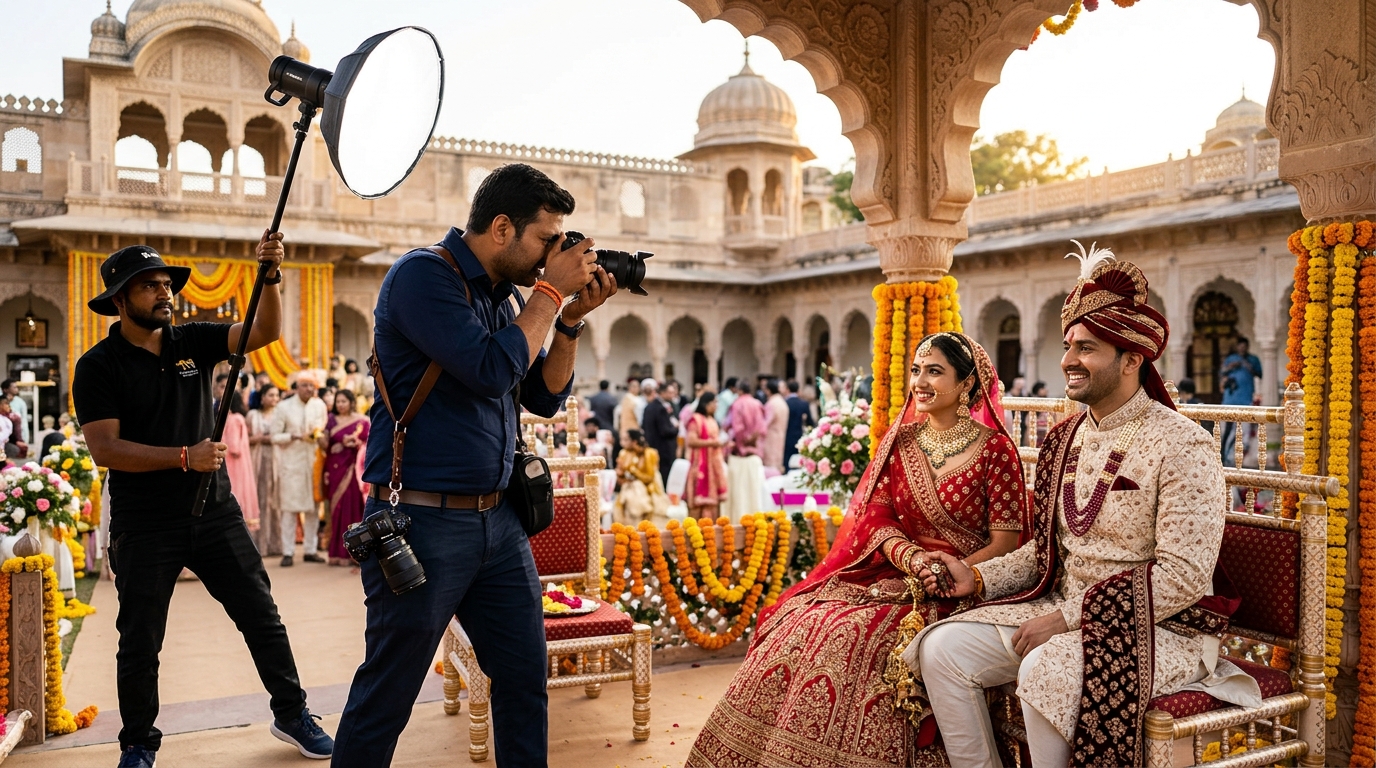
Top wedding studios in 2026 standardize on a 2-Man High-Mobility Strobe Rig that delivers studio-grade punch while keeping the crew light on their feet:
The Strobe Package:
- Primary Strobe: Godox AD200 Pro II or AD300 Pro (bare-bulb head installed for maximum parabolic reflector spread).
- Trigger: Godox X3 (Nano) or XPro II TTL Wireless Flash Trigger running in Manual mode with HSS enabled.
- Mobility Support: Heavy-duty carbon fiber painter's monopod or dedicated boom pole (such as the Godox AD-S9 or Manfrotto 001B) with a quick-release ball head.
- Modifier: 65cm (26-inch) quick-collapse octabox or deep silver parabolic softbox with inner and outer diffusion sheets removed, using only the front grid or bare silver interior to maximize directional Lux output.
- Backup Power: 2x spare lithium-ion battery packs kept in the assistant's shoulder bag (WB29B / WB300P).
The "Sun as Rim Light" Lighting Architecture:
The biggest secret of top wedding photographers is turning the midday sun into an asset rather than an enemy. Never position the couple facing directly into the sun. Instead, use this 3-step positioning geometry:
- Position the Sun Behind the Couple (Backlight / Rim Light): Place the couple so the harsh 12 PM sun hits their backs and hair at a 45-degree angle. This creates an incandescent golden rim light that separates their dark hair and embroidered garments from the background. Their faces are now in clean, even open shadow.
- Position the Assistant with the Strobe: Have your lighting assistant stand 2 to 3 meters away from the couple at a 30-to-45-degree angle off-axis from your camera lens, raising the monopod so the modifier is roughly 7 feet high, pointing down at a 45-degree angle.
- Feather the Light Across Both Faces: Aim the softbox slightly in front of the bride and groom rather than dead-center. Feathering the edge of the light creates a soft, wrap-around dimensional transition from highlights to shadows across their cheekbones.
To achieve that dramatic, rich editorial look where the sky remains deep sapphire blue and palace archways retain rich golden saturation, meter the ambient background first. Set your camera exposure (ISO 100, 1/4000s, f/1.8) so the background is underexposed by exactly -0.7 to -1.3 stops. Then, turn on your strobe trigger and bring up your flash power (typically 1/2 to 1/1 full power on an AD200 Pro II) until the couple's faces are exposed to 0 EV. Your subjects will pop with breathtaking three-dimensional depth!
🎨 4. Mastering Skin Tones & Zari Details: Overpowering Ambient Without Looking Artificial
A major fear among wedding photographers when introducing off-camera flash is the dreaded "deer in headlights" look—where the couple appears pasted onto the background like a flat cut-out. In Indian wedding photography, this issue is compounded by delicate skin tones and opulent textile fabrics.
Protecting Authentic Indian Melanin:
Indian skin tones span a rich spectrum of olive, warm caramel, and deep bronze undertones. Standard flash tubes emit light at approximately 5600K to 6000K daylight balance. However, when 5600K flash light strikes skin covered with HD bridal makeup, foundation, and loose setting powders, it can reflect a chalky, bluish-grey cast if underexposed or mismatched against the warm Rajasthani stones.
The Fix: Attach a 1/4 CTO (Color Temperature Orange) gel to your bare bulb inside the softbox. This warms the strobe output to approximately 5100K–5200K. In your camera, set a custom Kelvin white balance between 5300K and 5500K. The couple's skin will glow with radiant warmth, while cool ambient sky tones behind them deepen into rich cinematic teal.
Preserving Micro-Contrast on Gold Zari:
Gold embroidery and metallic sequins react violently to front-facing on-camera flash, resulting in specular white glare spots that destroy embroidery patterns. By placing your AD200 Pro II off-camera at a 45-degree raking angle, the light grazes across the surface of the fabric. This creates microscopic micro-shadows behind each gold thread, enhancing the tactile 3D weave of luxury garments in the final RAW file.
🚀 5. The Post-Shoot Bottleneck: Culling 3,000 High-Speed Frames in 15 Minutes
When shooting fast-moving Baraat processions or energetic couple portraits with high-speed sync, burst shooting is essential to capture the fleeting microseconds between blinking and smiling. Modern flagship cameras like the Sony A7 IV or Canon R6 Mark II easily clock 10 to 12 frames per second.
In a single 2-hour outdoor portrait and Baraat session, a 2-photographer team routinely generates 3,000 to 5,000 uncompressed RAW files totaling over 150 GB of data.
This creates a massive post-production nightmare:
- Uploading 150 GB to slow cloud proofing platforms takes overnight on typical studio broadband.
- Clients receive unorganized folders containing 40 nearly identical variations of the same high-speed burst.
- Couples get overwhelmed, delay their photo selections for 3 to 6 months, and leave your final 30% balance payment trapped in limbo.
- Studio editors waste 4 to 6 hours manually searching hard drives to locate and copy the 250 selected RAW files for retouching.
✅ 4-Step Actionable Checklist: Midday HSS Shoot Protocol
Print this protocol or save it on your phone before stepping out into your next outdoor Indian wedding session:
1️⃣ Pre-Shoot Sync Verification: Ensure your camera body is in Manual exposure mode and your flash trigger (Godox X3 / XPro II) has High-Speed Sync (HSS / SYNC icon) toggled ON. Turn off "Silent Shutter / Electronic Shutter" on cameras with rolling shutter sensors to avoid banding.
2️⃣ Backlight Angle Check: Position the bride and groom with the direct midday sun directly behind them or at a 45-degree angle over their shoulder to serve as a rim light. Check that no harsh shadow triangles fall across their noses.
3️⃣ Dial In Background Negative Compensation: At ISO 100 and f/1.4 or f/1.8, dial your shutter speed up to 1/2000s–1/4000s until the background sky and architecture are underexposed by -1 stop on your exposure meter.
4️⃣ Key Strobe Feathering: Have your assistant hold the 65cm modifier 2.5 meters away at a 45-degree angle, elevated 7 feet high. Fire a test burst at 1/2 power. Adjust flash output up or down until the couple's face matches 0 EV while background depth is preserved.
❓ Frequently Asked Questions (FAQ)
Q1: Can I use a Variable ND filter instead of High-Speed Sync (HSS)?
Yes, a high-quality 2–5 stop Variable ND filter allows you to keep your shutter speed at 1/200s or 1/250s while shooting wide open at f/1.4, which preserves 100% of your flash tube's rated power. However, ND filters have distinct drawbacks in fast-paced wedding environments: variable NDs often introduce color shifts (yellow/magenta casts) or the dreaded "X-pattern" polarization vignette on wide lenses (24mm–35mm). Furthermore, when moving rapidly from bright outdoor sunlight into a dark indoor Mandap, taking off or adjusting screw-on filters wastes precious seconds. For sheer speed and color purity, dedicated HSS strobes remain the industry standard.
Q2: Will shooting HSS at 1/8000s damage or overheat my Godox AD200 Pro II?
Modern strobes like the Godox AD200 Pro II feature built-in thermal protection sensors and improved heat-sink circulation. While firing continuous 1/1 full-power bursts in 40°C Indian summer heat will trigger thermal throttling after 40–50 consecutive pops, shooting at 1/2 or 1/4 power with short pauses allows you to shoot hundreds of frames reliably without shutdown. Keep a spare charged battery pack in an insulated shade pouch to ensure consistent recycle times.
Q3: How do I manage the massive volume of high-speed burst files after an outdoor wedding?
The most efficient workflow is to run an initial AI cull (e.g., in Aftershoot or Narrative Select) to reject closed eyes and blurry frames, then immediately export web-compressed JPEG proofs into Pixelect. By sending the couple a private WhatsApp PIN gallery divided into ceremony tabs, they can easily star their favorites on their smartphones within 48 hours. Once selected, Pixelect's 1-Click Local RAW Auto-Copy scans your external hard drives and copies only the winning RAW files in 15 seconds, eliminating manual search fatigue.
Ready to Cut 5+ Hours from Every Wedding Delivery?
Deliver breathtaking WhatsApp photo proofing galleries with instant PIN access to couples. When they finish selecting, let Pixelect's 1-Click Local RAW Auto-Copy locate and copy their selected RAW files from your hard drive in just 15 seconds.
Start Free Pixelect Event →