📋 Executive Summary: The Aerial Edge in High-Ticket Indian Wedding Cinema
In 2026, drone cinematography in Indian weddings is no longer just a luxury bonus—it is a mandatory anchor for ₹2 Lakh+ cinematic wedding packages. Capturing the grandeur of an 800-person Baraat, palatial Rajasthani heritage courtyards, and grand open-air Varmalas requires mastering dynamic multi-axis camera movements, eliminating devastating radio-frequency (RF) signal drops caused by 10kW banquet generators and wireless DMX rigs, taming dense Havan smoke in low light, and strictly adhering to Indian DGCA Digital Sky compliance. This masterclass unveils the exact field-tested flight profiles, camera sensor configurations, fail-safe protocols, and post-shoot delivery pipelines used by India’s elite wedding studios.
🚁 1. The High-Stakes Reality of Indian Wedding Aerial Cinematography in 2026
Over the past three wedding seasons, Indian wedding cinema has experienced a dramatic visual revolution. Couples and luxury wedding planners no longer settle for static overhead drone shots that look like generic Google Earth snapshots. They expect fluid, cinematic camera moves that weave naturally into the narrative of the wedding film—descending gracefully through ancient carved sandstone jharokhas, executing buttery 360-degree parallax orbits around a groom atop a decorated Ghodi, and tracking dramatic night-time cold pyro fountains at 60 frames per second.
However, operating an unmanned aerial vehicle (UAV) in the midst of an authentic Indian wedding is one of the most hostile flight environments in commercial cinematography. Unlike a peaceful landscape shoot, a Baraat street procession involves 500 to 1,000 highly energetic guests moving unpredictably down narrow lanes, high-decibel brass bands, flying Gulal and colored smoke canisters, handheld sparklers throwing 1,200°C titanium slag, and low-hanging municipal power cables crisscrossing unmapped overhead spaces.
To add to the complexity, the sheer density of multi-camera wireless video transmitters (such as Hollyland and Teradek links), mobile phone repeaters, and heavy audio soundboard wireless systems at luxury banquet venues creates a notorious "RF Bermuda Triangle" that can sever remote controller signals in an instant. Mastering drone cinematography in this industry requires equal parts creative vision, aeronautical precision, and bulletproof operational discipline.
Never engage DJI MasterShots, QuickShots, or automated ActiveTrack during a live Baraat, Varmala, or crowded reception entrance. Optical obstacle avoidance sensors are easily blinded by sudden cold pyro smoke, laser beams, or tree branches in twilight, while intelligent tracking algorithms can instantly latch onto a dancing guest holding a sparkler instead of the groom, causing abrupt jerky maneuvers or catastrophic low-altitude tree strikes. Always fly in full Manual (Position/Normal or Cine) mode with dual-stick muscle memory.
📡 2. Overcoming the Banquet Hall RF Bermuda Triangle: Signal Jamming & Interference Protocols
Every experienced wedding drone operator has felt the sudden chill of seeing their live video feed freeze into digital artifacts, followed by the terrifying red screen warning: "Remote Controller Signal Lost. Returning to Home." In Indian wedding hotspots—from the farmhouse clusters of Chattarpur (Delhi) and Golden Palms (Bengaluru) to luxury palace properties in Udaipur and Jaipur—airspace is saturated with electromagnetic noise.
The primary culprits are 2.4 GHz and 5.8 GHz wireless DMX stage lighting consoles, multi-channel wireless bodypack transmitters, high-output Wi-Fi 6 access points, and unshielded 60kVA diesel generator cables running along perimeter walls. To maintain an unbreakable control link throughout critical ceremonial moments, top studios deploy four non-negotiable RF protocols:
- Manual Frequency Selection over Auto-Hopping: In areas with heavy crowd interference, the automatic hopping protocol can experience momentary latency spikes as it scans crowded spectrums. Prior to takeoff, open the transmission menu and manually lock into a clean, low-noise channel within the 5.8 GHz band for short-range high-bitrate line-of-sight flying, or 2.4 GHz for superior penetration through banquet structures.
- Precision Antenna Polarization: The flat faces of your remote controller antennas must always remain perpendicular to the aircraft’s position in the sky. Pointing the tips of the antennas directly at the drone creates a transmission null cone, causing instantaneous signal dropouts even when the drone is merely 40 meters away.
- Dynamic Return-to-Home (RTH) Altitude Staging: Never leave default RTH altitude at 30 meters. Before powering up the motors, inspect the venue for the highest physical obstruction—whether it is a 45-meter heritage palace turret, a high-tension electrical pylon, or a towering floral stage truss—and set your failsafe RTH altitude at least 15 meters above that obstacle (e.g., 60 meters).
- Magnetic Compass Calibration Hygiene: Never calibrate your UAV compass on reinforced concrete slabs, tiled hotel porticos containing steel rebar, or near underground power transformers. Step out onto open grass or natural soil to perform calibrations, preventing compass drift errors that cause erratic "toilet-bowling" flight patterns mid-air.
🎥 3. Five Signature Indian Wedding Aerial Moves That Elevate Teaser Trailers
Cinematic aerial filming is all about creating perspective shifts that cannot be captured by ground-based gimbal operators. Integrating these five signature camera moves will immediately lift your wedding teaser films into the top tier of cinematic storytelling:
1. The "Descending Ghodi Reveal" (Vertical Parallax Arc)
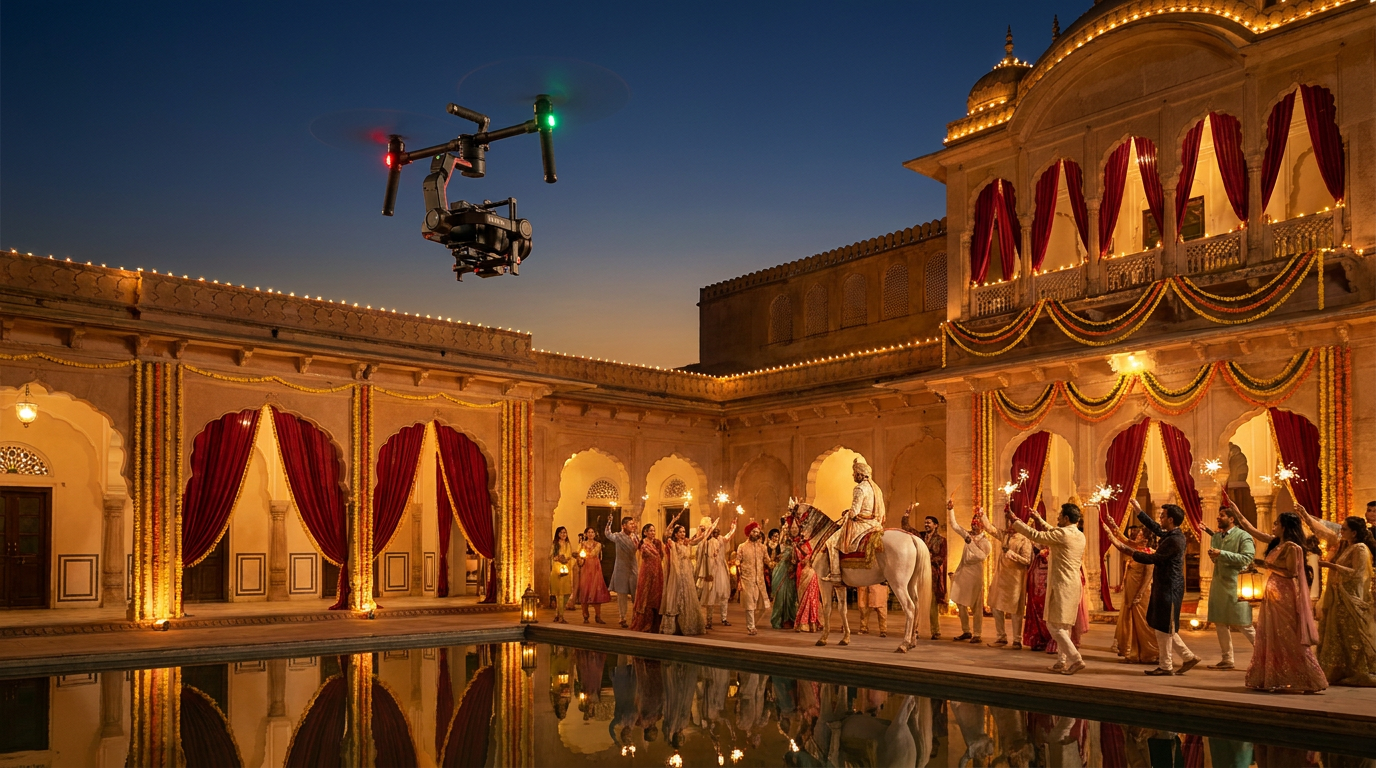
Start the drone at an altitude of 55 meters, positioned directly above the entrance of the wedding venue, with the camera tilted down at 30 degrees to capture the illuminated venue gates and city backdrop. As the Baraat band reaches a crescendo, initiate a simultaneous descent, forward pitch, and upward camera tilt, bringing the aircraft down to 12 meters right in front of the groom. The resulting parallax effect compresses the background palace against the majestic presence of the groom on horseback.
2. The "Royal Mandap 360° Symmetrical Orbit"
For open-air palace or poolside mandaps, execute a smooth, low-speed circular orbit at an altitude of 18 meters with a 45-degree downward gimbal angle. Keep the sacred Havan fire dead-center in your third-of-an-axis grid while maintaining a constant flight speed of 8 to 12 km/h. This shot reveals the architectural geometry of the mandap, the circular seating arrangement of the families, and the surrounding reflection pools in one unbroken, regal movement.
3. The "Phoolon Ki Chaadar Top-Down Push" (Bird’s-Eye Tracking)
Tilt the camera fully down to 90 degrees (Nadir view) at an altitude of 20 to 25 meters directly above the bride’s entrance pathway. As the brothers carry the ornate floral canopy (Phoolon Ki Chaadar) forward, fly the drone backward in smooth synchronization with her walking pace. This perspective captures the intricate geometric patterns of the bridal lehenga, the floral canopy craftsmanship, and the emotional symmetry of the procession that ground cameras physically cannot document.
4. The "Varmala Pyro Pullback" (Explosive Wide Expansion)
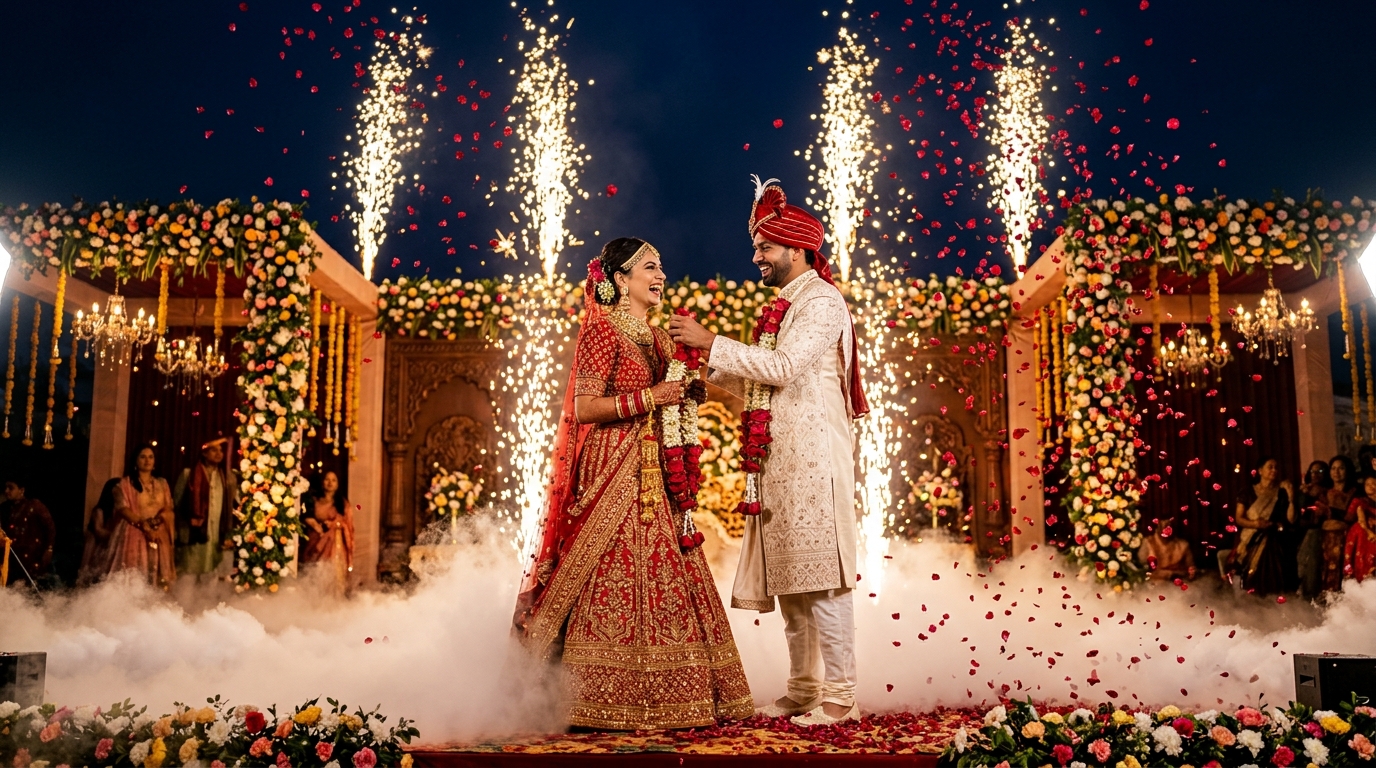
Coordinate with the stage pyro team via walkie-talkie. Hover 8 meters away from the couple on the hydraulic revolving stage at eye level. The exact second the garlands are exchanged and the cold pyro fountains ignite with dense CO2 smoke blasts, pull straight back while ascending at full throttle and tilting the camera down gradually. This moves the viewer from an intimate couple reaction shot into a breathtaking stadium-scale spectacle showing 1,000 cheering guests under a golden shower of sparks.
5. The "Twilight Venue Fly-Over & Horizon Reveal"
Fly during civil twilight (the 20-minute golden-blue hour window right after sunset). Begin low over the illuminated fountain lawns, then fly forward across the venue roofline while slowly tilting the gimbal up to reveal the glowing illuminated domes against the deep indigo horizon. This is the ultimate opening establishing shot for luxury wedding films.
If you are shooting high-budget luxury weddings with the DJI Inspire 3 or dual-controller DJI Mavic 3 Pro Cine, decouple flight controls from camera controls. One pilot focuses 100% on spatial clearance, wind vectors, and smooth stick movements, while the dedicated camera operator handles gimbal pan, tilt, optical zoom switching (24mm vs 70mm vs 166mm), and aperture tracking. This eliminates the telltale micro-stutters that occur when a single pilot attempts to pan and steer simultaneously.
🌙 4. Low-Light Mandap & Night Aerial Mastery: Sensors, Shutter Speeds & ISO Ceilings
Unlike Western daytime lawn weddings, the most emotionally charged rituals in Indian weddings—the Varmala, Saat Phere, Kanyadaan, and Sindoor Daan—frequently take place outdoors under the night sky or inside semi-covered heritage courtyards between 10:00 PM and 3:00 AM. Operating small 1/2-inch or 1/1.3-inch drone sensors in these conditions results in muddy shadow noise, severe chromatic banding, and blown-out highlights from harsh halogen stage spotlights.
To achieve pristine, noise-free 10-bit aerial footage at night, industry professionals rely on larger sensor formats (such as the 4/3 CMOS Hasselblad sensor found in the DJI Mavic 3 series) and adhere to the following exposure matrix:
- Gamma Curve Selection (D-Log M vs HLG): In low-light night wedding environments, shooting flat D-Log can sometimes introduce unwanted chroma noise in pushed deep shadows. Switching to 10-bit HLG (Hybrid Log-Gamma) provides an exceptional balance between dynamic range preservation across glowing stage fixtures and instant shadow cleanliness without needing heavy noise-reduction plugins in post.
- The 180-Degree Shutter Rule Exception: While a 1/50s shutter speed at 24fps is standard for cinematic motion blur, flying at night over bright moving crowd elements with sparklers can cause excessive motion smearing. Pushing the shutter speed slightly to 1/80s or 1/100s while opening the aperture to f/2.8 keeps individual sparkler trails crisp and prevents the groom’s sherwani embroidery from turning into a blurry smear during fast rotations.
- ISO Ceiling Thresholds: Cap your auto/manual ISO at ISO 1600 (or ISO 3200 maximum on dual-native ISO sensors). Never rely on ISO 6400+ on consumer drone platforms; the resulting grain pattern destroys the delicate gold zari threading of Indian bridal couture. If the mandap is too dark, coordinate with your ground lighting crew to feather an off-camera Godox continuous LED panel at 15% power toward the canopy.
- Battery Thermal Management: In North Indian winter weddings (Delhi, Punjab, Rajasthan) where midnight temperatures plunge to 4°C to 8°C, lithium-polymer drone batteries experience sudden voltage sags. Keep spare batteries inside insulated thermal bags with warm gel packs until right before flight, and land immediately once battery levels touch 25%—never push into the 15% critical reserve zone in freezing night air.
⚖️ 5. DGCA Regulations, Digital Sky & Indian Drone Law Compliance
Flying commercially in India without understanding the regulatory framework established by the Directorate General of Civil Aviation (DGCA) under the Drone Rules 2021 (and subsequent amendments) puts your studio at risk of heavy financial penalties, gear confiscation by local police, or venue blacklisting.
Commercial wedding drone operators must operate within the Micro category (drones weighing between 250 grams and 2 kilograms) or Nano category (under 250 grams). Key legal requirements include:
- UIN (Unique Identification Number): Every commercial drone must be registered on the DGCA Digital Sky platform and display a tamper-proof physical UIN plate affixed to the airframe.
- Remote Pilot Certificate (RPC): Operating a Micro-category drone for commercial gain requires a valid RPC issued by an authorized DGCA Remote Pilot Training Organization (RPTO).
- Airspace Zone Checks: Always inspect the Digital Sky interactive airspace map prior to booking. Flying in Green Zones requires no prior air traffic permission up to 400 feet AGL (above ground level), whereas Yellow Zones (within 5–12 km of airports) and Red Zones (defense establishments and VVIP corridors) require explicit digital clearances.
- Third-Party Liability Insurance: Possessing active third-party commercial UAV insurance is mandatory in India, safeguarding your studio against accidental property damage or crowd injury claims.
Spectacular aerial cinematography is only half the battle. A jaw-dropping drone shot is worthless if the multi-camera footage remains trapped on high-speed micro-SD cards, bottlenecks your editors for weeks, or gets buried in unorganized hard drive folders. The most profitable wedding studios pair aerial excellence with rapid, automated post-shoot workflows that turn multi-camera footage into client selections and viral social media teasers within 48 hours.
📊 6. Workflow Comparison: Old Manual Drone Shooting vs Modern Pixelect-Powered Studio
✅ 7. The 4-Step Pre-Flight & Post-Shoot Wedding Drone Execution Checklist
Keep this checklist in your flight bag or saved on your pilot's phone to guarantee 100% mission success and zero gear mishaps on wedding day:
- 1️⃣ Pre-Event Airspace & Venue Reconnaissance: Check Digital Sky airspace maps for red/yellow flight zones; verify venue clearance with the banquet event director; visually inspect overhead wires, decorative chandeliers, and tree canopies. ✅
- 2️⃣ Power Logistics & Thermal Readiness: Ensure all flight batteries are conditioned at 100%; verify controller charge; keep spare batteries in insulated thermal pouches during cold winter nights; calibrate compass on natural grass away from rebar. ✅
- 3️⃣ In-Flight Security & Signal Safety: Lock transmission to clean 5.8 GHz spectrum; configure fail-safe RTH height to 15m above the highest palace structure; maintain visual line of sight (VLOS) with a dedicated ground spotter during the Baraat. ✅
- 4️⃣ Rapid Local Ingestion & Client Proofing: Immediately offload drone Micro-SD cards alongside Sony/Canon ground camera footage into your central editing workstation; use Pixelect to auto-extract selected hero takes in seconds and launch client proofing galleries. ✅
❓ 8. Frequently Asked Questions (FAQs)
Q1: Can we legally and safely fly drones indoors inside hotel ballrooms and glass banquet halls?
Yes, but standard GPS-reliant camera drones (like the Mavic 3) should never be flown indoors without extreme caution because steel pillars, reflective glass walls, and magnetic ceiling trusses disable satellite positioning, forcing the drone into drift-prone ATTI mode. For indoor ballrooms, use a specialized lightweight Cinewhoop or micro-FPV drone equipped with full 360-degree ducted propeller guards, optical flow positioning, and an experienced manual pilot. Always secure written permission from the venue management first.
Q2: What should the pilot do if the video transmission disconnects mid-flight above an 800-person Baraat?
First, remain calm and resist the urge to vigorously jerk the control sticks blindly. Maintain your antenna positioning and take two steps backward or toward higher ground to restore line of sight. If signal is not restored within 5 to 8 seconds, the drone’s programmed fail-safe will engage, ascending vertically to your pre-configured RTH altitude (e.g., 60m) clear of all street wires and tree branches, and navigate back toward the home point. Once the aircraft re-enters line of sight overhead, the control link will reconnect, allowing you to cancel RTH and resume manual landing.
Q3: How do we prevent high-resolution drone footage and multi-camera RAW files from choking our studio workflow?
High-bitrate 4K 10-bit aerial files combined with multi-camera ground RAWs (often 15,000+ files per wedding) create severe storage and proofing gridlocks. Instead of waiting hours to upload gigabytes of unculled footage to slow cloud drives, top studios use Pixelect SmartSelection to sort, cull, and auto-copy selected files locally in under 15 seconds. You can then deliver compressed, high-speed mobile client selection galleries via WhatsApp PIN, cutting client turnaround time from four months to under a week.
Eliminate Multi-Camera Culling Chaos & Deliver in Record Time
Pair your breathtaking cinematic drone shots with the fastest photo selection platform built specifically for Indian wedding studios. Generate instant WhatsApp PIN client galleries and auto-copy selected RAW files from local storage in just 15 seconds—zero cloud upload lag.