⚡ Executive Summary: The Untold Truth About Indian Wedding Client Satisfaction
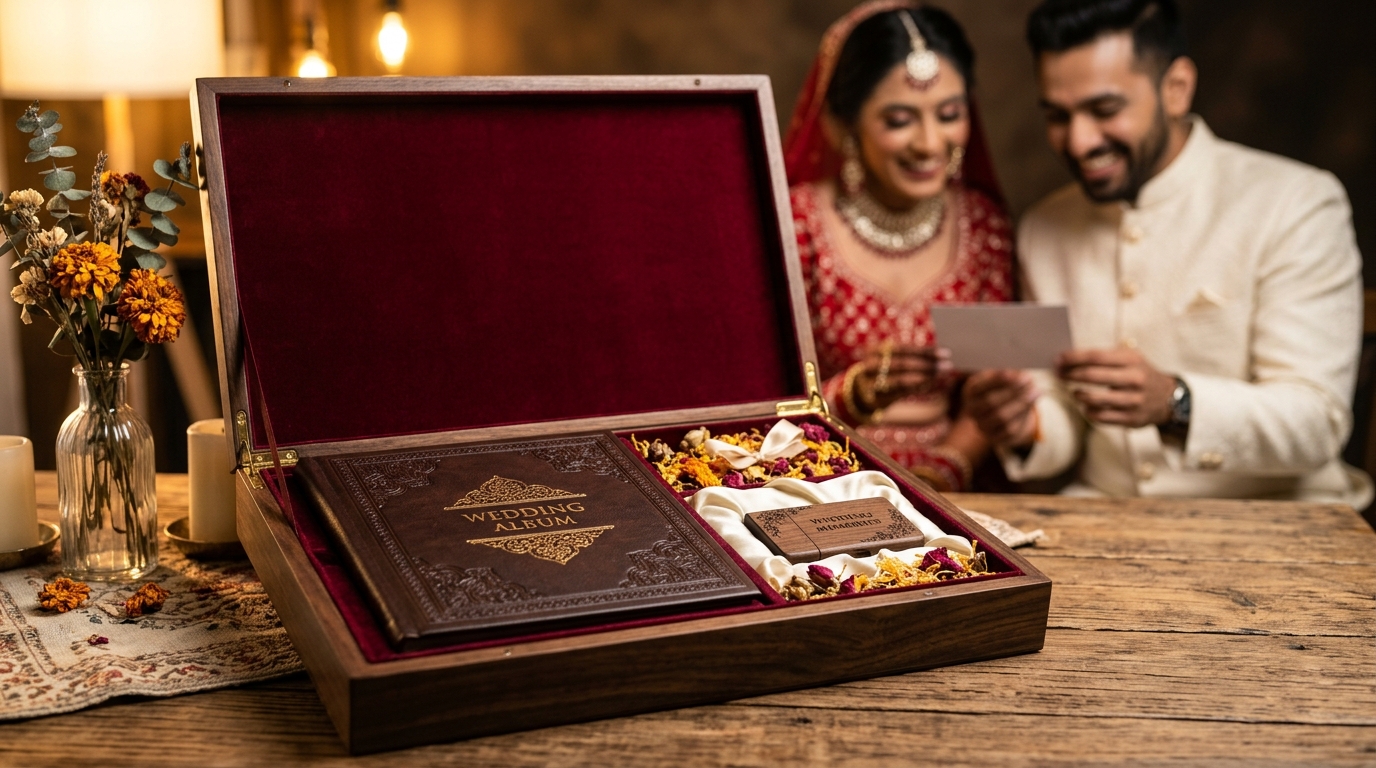
Ask any seasoned Indian wedding studio owner why clients delay album selection by six months or withhold the final 20% balance payment, and the answer is rarely the cinematic drone shots or the couple's golden hour portrait. In over 82% of disputed wedding deliveries, the core complaint is personal: "Aapne Dulhe ke Mama-Mami ki stage photo nahi li!" or "Dada-Dadi got exhausted standing in line and left before their family portrait was taken." In India, weddings are family mergers involving 400 to 1,200 guests, and missed VIP portraits are considered a permanent cultural dishonor. This masterclass reveals the exact 4-tier family hierarchy, the 2-cousin stage captain framework, the 20-minute grandfather-first batching protocol, and the modern AI Face Search distribution pipeline top Indian studios use to eliminate stage chaos, guarantee zero missed elders, and convert family delight into five-figure referral bookings.
📸 1. The "Aapne Mama Ki Photo Miss Kar Di" Nightmare: Why Family Portraits Break Studio Reputations
Every wedding photographer who has shot more than ten Indian weddings knows the sudden, gut-wrenching dread of the post-wedding feedback call. You spent 14 hours capturing breathtaking bridal portraits on an 85mm f/1.2 lens, executed flawless off-camera flash lighting during the Jaimala, and balanced mixed-Kelvin stage LEDs with surgical precision. You delivered 3,000 color-graded photographs that look straight out of Vogue India.
Yet, the bride's father is furious on WhatsApp. The groom's mother refuses to approve the raw selection. Why? Because during the chaotic two-hour reception stage rush, when 250 distant acquaintances crowded the mandap, the groom's maternal uncle (Mama ji) from Kanpur was eating snacks in the dining hall, and nobody called him for a formal family portrait.
In Western wedding photography, a standard shot list might consist of 10 to 12 simple combinations: bride with parents, groom with parents, combined wedding party, and siblings. In an Indian wedding, family dynamics are profoundly multi-layered. You have paternal grandparents (Dada-Dadi), maternal grandparents (Nana-Nani), paternal uncles and aunts (Chacha-Chachi, Tauji-Taiji, Bua-Phupha), maternal uncles and aunts (Mama-Mami, Mausi-Mausa), first cousins, godparents, family pandits, and elderly village patrons who traveled 500 kilometers specifically to bless the couple.
Leaving stage family photos to chance or asking the bride and groom to "wave over whoever is nearby" is suicidal for your studio reputation. The bride is exhausted wearing a 15-kilogram lehenga and heavy jewelry; the groom is dehydrated; and both are blinded by stage floodlights. Expecting them to remember whether Chacha ji was photographed between 150 distant office colleagues guarantees catastrophic omissions and bitter post-wedding disputes.
When an elder is missed, the emotional damage spreads through family WhatsApp groups like wildfire. When the album design phase arrives, the client freezes: "We cannot finalize the album because we don't have a picture of Nana ji blessing the bride." The project stalls for six months, hard drives remain clogged, and your final payment remains locked in limbo.
Top high-earning studios across Mumbai, Delhi, Bengaluru, and Kolkata do not treat family stage portraits as an afterthought. They treat it as a clinical, high-speed military operation executed with royal grace.
📋 2. The 4-Tier Indian Family Hierarchy: The Pre-Wedding Digital Intake Matrix
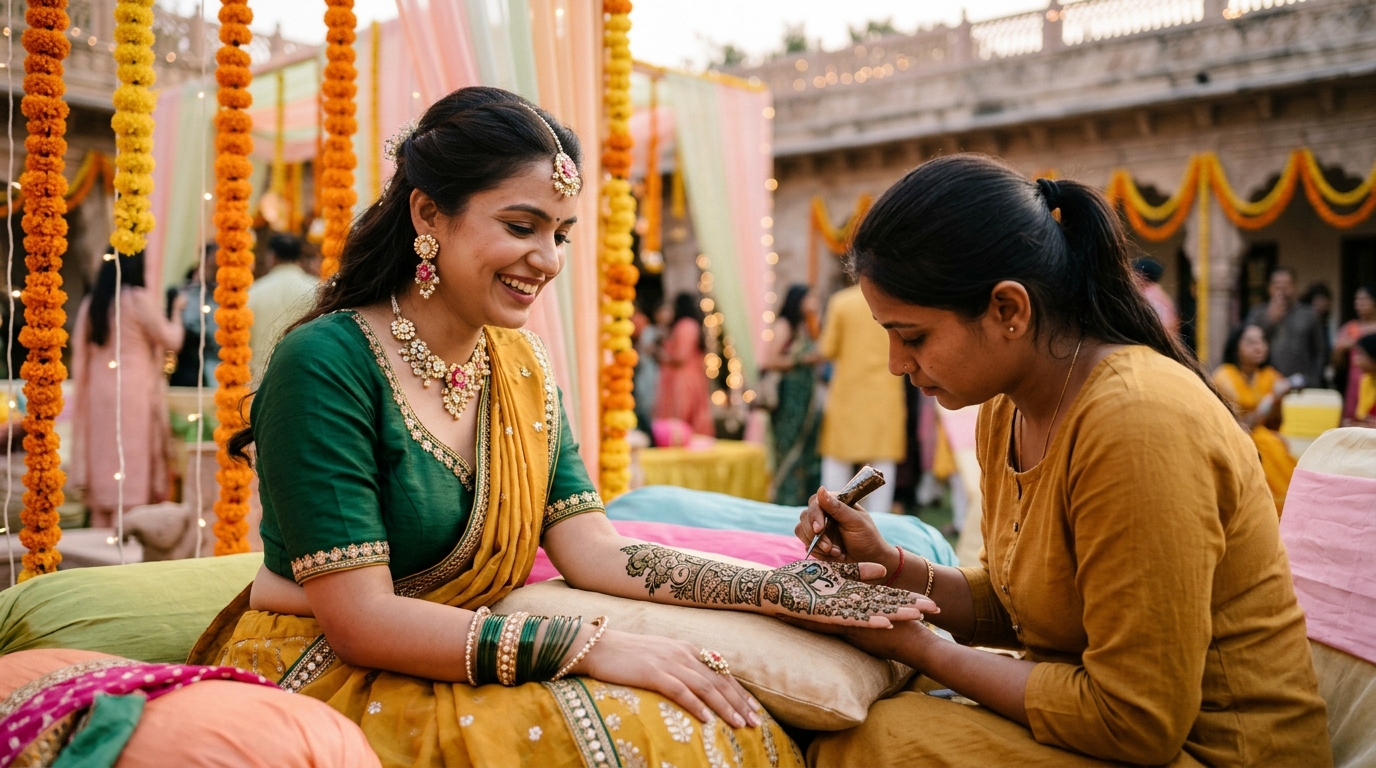
Eliminating stage chaos begins two weeks before the first turmeric paste touches the bride's cheek at Haldi. You cannot organize 40 people on a stage if you don't know who they are, what their names are, or what emotional weight they carry in the family hierarchy.
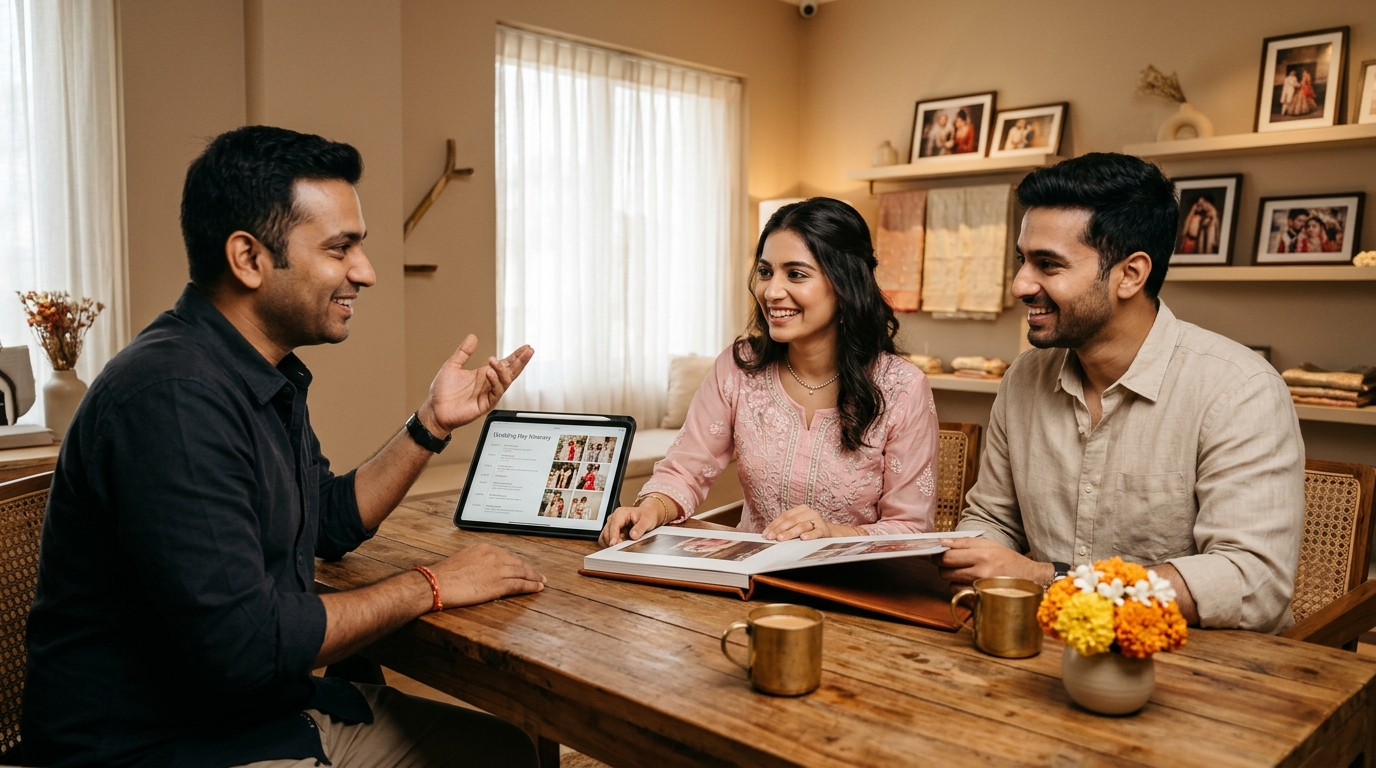
Elite studios send an interactive digital questionnaire to the couple 14 days before the wedding. This intake questionnaire divides the family into a strict 4-Tier Priority Matrix:
🏛️ The 4-Tier VIP Family Intake Matrix
- Tier 1 — The Non-Negotiable Elders (VIP Gold): Paternal Grandparents (Dada-Dadi), Maternal Grandparents (Nana-Nani), Great-Grandparents, and bed-ridden or mobility-assisted elders. These individuals must be photographed within the first 15 minutes of stage seating, before fatigue sets in.
- Tier 2 — The Immediate Nuclear Units (VIP Silver): Bride's Parents & Siblings, Groom's Parents & Siblings, along with brothers-in-law (Jija ji), sisters-in-law (Bhabhi), and immediate nieces and nephews.
- Tier 3 — The Pillar Relatives (VIP Bronze): Chacha-Chachi, Tauji-Taiji, Mama-Mami, Bua-Phupha, and Mausi-Mausa. In many Indian cultures, the Mama (maternal uncle) carries immense ceremonial significance (e.g., Mameru/Mayra in Gujarati and Marwari weddings, or walking the bride to the mandap in Bengali and Punjabi weddings).
- Tier 4 — Extended Family, Cousins & Social Circles: First cousins, college friends, corporate colleagues, family doctors, and community neighbors.
Along with names, the questionnaire collects one crucial piece of intelligence: Mobility and Health Constraints. Does Dadaji use a wheelchair? Does Naniji have knee arthritis that makes climbing stage stairs impossible? Knowing this in advance allows your team to prepare a comfortable antique sofa or plan ground-level portraits before the couple ascends the elevated reception stage.
48 hours before the reception, generate a crisp, beautifully designed 1-page PDF or WhatsApp graphic titled "Family VIP Photo Schedule". It clearly states: "Stage Family Portraits will commence immediately after Jaimala at 8:30 PM sharp, beginning with Grandparents and Immediate Family. Please ensure elders are near the stage area." When the bride's father forwards this directly to family WhatsApp groups, elders arrive on time without confusion.
👥 3. The Two-Cousin "Stage Captain" System: How to Stop Screaming Over Loud DJs
Here is an embarrassing truth about Indian wedding stages: a photographer holding a microphone or shouting at the top of their lungs, "Ramesh Uncle kahan hain? Sunita Aunty ko bulao!" looks amateurish, disrupts the wedding elegance, and fails 90% of the time because the photographer has no idea what Ramesh Uncle looks like.
The single most effective operational innovation for Indian wedding studios is the Two-Cousin Stage Captain System.
During your pre-wedding consultation, make one firm operational requirement:
"We need two designated Family Photo Captains: one energetic, socially connected cousin from the bride's side, and one from the groom's side. These individuals know every uncle, aunt, and grandparent by face and voice. They will be our VIP liaisons for exactly 25 minutes on stage."
How the system operates in real-time:
- The Bride's Captain manages the queue on stage left. While Tier 1 is being photographed, they physically locate Tier 2 (Immediate Family) from the dining hall or lounge and have them queued on deck.
- The Groom's Captain manages stage right. They hold a laminated copy (or digital smartphone checklist) of the pre-approved VIP matrix. As each family group steps onto the stage, the captain checks off their name.
- Your Second Shooter / Assistant stands beside the captains with a wireless headset or subtle clipboard. The main photographer never lowers the camera, never looks around the hall searching for guests, and never loses eye contact with the couple.
This transforms your presence from a stressed, shouting vendor into a calm, luxury directorial team that commands total respect from the family patriarchs.
⏱️ 4. The 20-Minute Clockwork Stage Protocol: Batching From Oldest Elders to Friends
To prevent stage fatigue and eliminate delays, top studios execute a rigid Subtractive & Additive Grouping Sequence. Never move people on and off the stage randomly. Every step onto the stage costs 45 to 60 seconds; random grouping turns a 20-minute session into an agonizing two-hour ordeal.
Follow this exact 7-step clockwork batching sequence:
🎯 The 7-Step Subtractive Batching Sequence (20-Minute Blueprint)
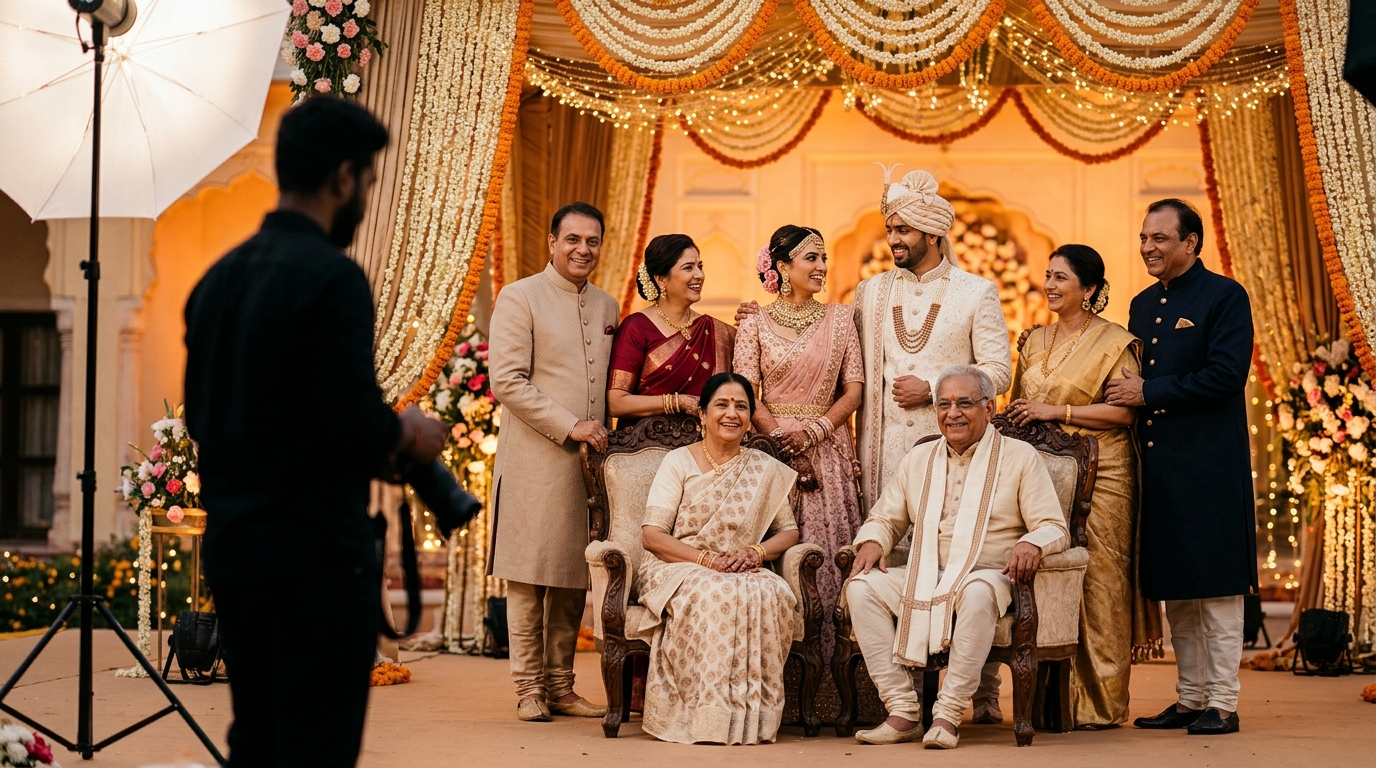
- Minute 0-4: Both Sets of Grandparents (Tier 1 Seated): Place comfortable royal chairs on stage for Dada-Dadi and Nana-Nani. Bride and groom stand behind or beside them. Capture formal portraits, touching feet for blessings (Aashirvaad), and warm laughing interactions. Escort grandparents to dinner immediately so they can rest.
- Minute 4-8: Bride's Complete Extended Family (Tier 2 + Tier 3): Bride's parents, siblings, Chacha, Mama, Bua all on stage together for the grand master clan portrait.
- Minute 8-11: Bride's Immediate Family Only (Tier 2 Subtractive): Uncles and aunts step off stage; bride's parents and siblings remain for the emotional nuclear family portrait.
- Minute 11-13: Bride & Parents Only: Siblings step aside. Crisp, formal portrait of bride with her mother and father.
- Minute 13-16: Groom's Complete Extended Family (Tier 2 + Tier 3): Groom's parents, siblings, Chacha, Mama, Bua step onto the stage for the groom's clan portrait.
- Minute 16-18: Groom's Immediate Family Only (Tier 2 Subtractive): Extended relatives step down; groom's parents and siblings remain.
- Minute 18-20: Both Parents Joint Portrait: Bride, Groom, Bride's Parents, and Groom's Parents together. The definitive frame for the opening spread of the wedding album.
Never shoot 12-person family groups at f/1.8 or f/2.2! Even on a flagship camera, depth of field is razor-thin; the front row will be sharp while uncles standing in the back row will be blurry. Stop down to f/5.6 or f/8, set shutter speed to 1/200s, and ensure dual speedlights or Godox AD200/V1 softboxes are angled at 45 degrees feathering across the entire group to avoid harsh shadows on faces.
⚡ 5. The Comparison: Chaotic Stage Free-For-All vs. The Pixelect VIP Protocol
How does a studio operating with ad-hoc manual methods compare to an elite studio powered by a standardized VIP intake matrix and modern proofing technology? The numbers and client feedback speak for themselves:
🚀 6. Delivering 400 Stage Portraits Instantly: The AI Face Search & WhatsApp Viral Loop
Capturing flawless VIP family photos is only half the battle. In an Indian wedding, every uncle, aunt, cousin, and family friend wants to see their stage photograph immediately:
"Bhaiya, hamari jo stage pe photo khichi thi, wo kab bhejoge? Hamare bete ko WhatsApp pe profile photo lagani hai!"
If you tell them to wait 45 days for a 60GB Google Drive link containing 4,000 unculled files, they will get frustrated, your client will get harassed, and your studio's brand equity evaporates.
Modern studios use Pixelect to transform stage photo delivery into a viral business generator:
- Instant WhatsApp Interactive PIN Gallery: Within 24 hours of the wedding, deliver a sleek, branded mobile proofing gallery directly to the bride, groom, and parents on WhatsApp. Zero app downloads, zero password friction. Family members enter their 4-digit PIN and review photos with smooth, Instagram-like speed.
- PixEvent AI Face Search for Guests: Place an elegant QR code on reception tables or at the venue exit. When guests scan the QR code and take a quick 2-second selfie, Pixelect's proprietary AI face recognition instantly scans the entire wedding gallery and displays only the photos containing that guest. Relatives download high-resolution, watermark-branded stage photos within seconds and share them across Instagram stories and family WhatsApp groups.
- 1-Click Local RAW Auto-Copy: When the bride, groom, and parents mark their selections for the wedding album (hearting their favorite family groupings), you don't spend six hours manually searching for DSC_4892.CR3 across external hard drives. Pixelect's desktop client automatically reads the client selections and copies all matching RAW files to your editing folder in 15 seconds flat.
📋 7. The 4-Step Studio Implementation Checklist
Ready to eliminate wedding stage chaos this upcoming wedding season? Implement this proven 4-step checklist on your next client booking:
Studio Readiness Checklist for Flawless Family Stage Portraits:
❓ Frequently Asked Questions (FAQs)
Q1: What should we do if distant guests jump the queue while we are shooting Tier 1 grandparents?
Have your designated Cousin Stage Captain politely intervene with warm authority: "Uncle ji, please give us just five minutes for Nana-Nani and Dada-Dadi's blessings as they need to rest; the stage will open for all friends and guests right after!" Relatives always respect elder priority when communicated clearly.
Q2: What is the ideal lens for Indian wedding stage family portraits?
A 24-70mm f/2.8 zoom lens at 35mm to 50mm focal length is the industry standard. Avoid ultra-wide lenses (16-24mm) for large groups because edge distortion will stretch relatives standing on the far left and right. Step back and shoot between 35mm and 50mm at f/5.6 or f/8 for natural, distortion-free perspective.
Pixelect organizes wedding photos into dedicated ceremony tabs (Jaimala, Stage Family, Haldi, Mandap). Parents and couples can review photos on their phones with a simple 4-digit PIN, filtering specifically for family portraits. Once approved, the 1-Click Local RAW Auto-Copy pulls all selected RAW files in seconds, letting your design team produce the album in 7 days instead of 6 months.
Ready to Run Clockwork Wedding Deliveries This Season?
Deliver interactive WhatsApp galleries to couples, delight wedding guests with AI Face Search, and auto-copy client-selected RAW files from your hard drive in 15 seconds flat.
Try Free Pixelect Event →