⚡ Executive Summary
The Indian wedding Sangeet and DJ night is arguably the most electrifying yet technically demanding environment in wedding photography. With dance choreographies exceeding 120 RPM, chaotic RGB moving-head stage lights casting heavy color casts, dense fog, and high-intensity lasers capable of permanently burning camera sensors, relying on ambient light or direct on-camera flash guarantees flat, noisy, and blurry results. This masterclass reveals the exact multi-light wireless off-camera flash (OCF) blueprints, rear-curtain shutter drag formulas, and stage safety protocols used by top Indian luxury studios. Learn how to freeze fast spins pin-sharp, paint dynamic ambient light streaks, protect your camera sensors, and cull 3,000+ burst shots in seconds using Pixelect SmartSelection.
💃 1. The High-Octane Sangeet Chaos: Why Ambient Light Alone Destroys Dance Floor Photos
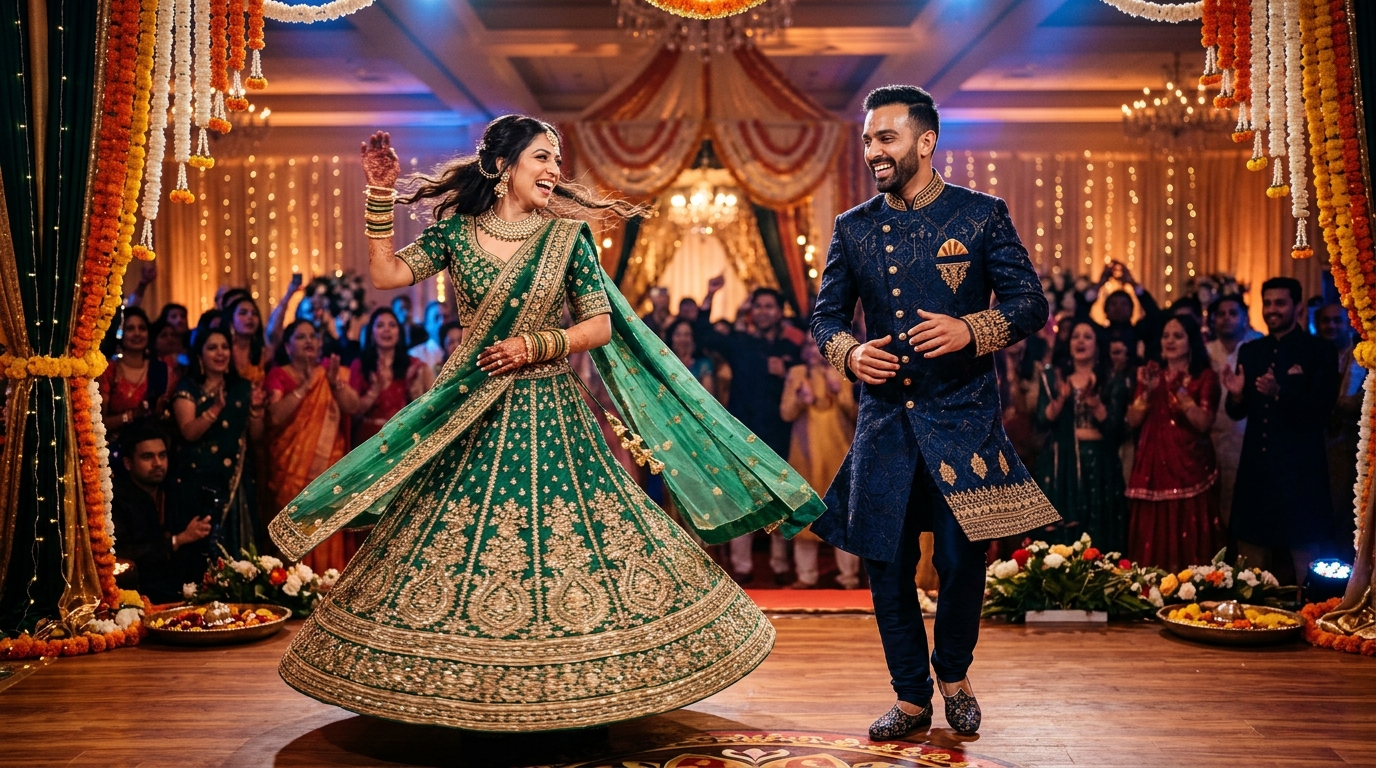
Step onto an Indian Sangeet dance floor at 10:30 PM, and you enter a sensory storm. Subwoofers vibrate the hall, confetti detonates overhead, and couples launch into high-speed Bollywood steps. For photographers relying strictly on ambient light, three critical failures inevitably occur:
- The 120 RPM Motion Blur Problem: When a bride executes rapid spins in a 15-kilogram designer lehenga, peripheral embroidery moves at over 15 km/h. Freezing this without flash requires shutter speeds of 1/800s to 1/1250s, forcing ISO to 12,800–25,600. This introduces severe chroma noise, softens jewelry details, and crushes shadow dynamic range.
- Cheap LED PWM Pulse & Color Banding: Many banquet halls use low-frequency pulse-width modulation (PWM) LED stage cans (100Hz–400Hz). Shooting faster than this cycle causes dark horizontal banding across frames. Furthermore, uncalibrated stage LEDs cast saturated monochromatic cyan, magenta, and neon yellow light that clips color channels beyond RAW recovery.
- The Muddy Monochromatic Wash: Flood lights in single hues flatten contrast. Faces blend into outfits, outfits blend into backdrops, and couples appear two-dimensional. Without a dedicated, high-CRI white light source, the true vibrancy of the celebration is lost.
⚡ 2. The 2-Light vs. 4-Light Cross-Lighting Setup: Sculpting 3D Separation in Pitch Darkness
Direct on-camera flash creates the flat 'deer-in-headlights' look: blown foreheads, harsh makeup shine, flat cheekbones, and an inky black background. Professional wedding photographers create cinematic depth by moving flashes off-camera.
The Proven 2-Light Cross-Rim Setup (200–400 Guest Ballrooms)
This is the workhorse setup for Indian wedding crews because it is swift, portable, and visually stunning:
- Backlight Rim Strobes (Light A & B): Place two Godox AD200 Pro II or V1 Pro strobes at diagonal opposite rear corners of the dance floor perimeter. Mount them on 9-foot air-cushioned stands anchored with 5kg sandbags.
- Height & Angle: Hoist lights to 8 feet and tilt them downward at 45 degrees towards the center stage. This clears guest heads while illuminating the couple's hair and shoulders.
- Honey-Comb Grids: Equip both rim lights with 30-degree MagGrids. Grids direct the beam tightly onto dancers, preventing direct flare into your lens when framing towards the stage.
- On-Camera Fill (Light C): Mount a speedlight on your hot shoe at low manual power (1/64) or TTL (-1.7 EV) with a MagSphere diffuser. This provides gentle eye catchlights without overpowering the rear rim.
The 4-Light Perimeter Arena Grid (600+ Mega Stages)
For grand ballroom stages, place one strobe on each of the four dance floor corners, assigned to Groups A, B, C, D on your Godox trigger at 1/32 power. Wherever you stand along the 360-degree perimeter, the strobe behind your subject acts as a rim light while perpendicular strobes provide cross-fill, eliminating stand repositioning mid-performance.
🌀 3. Shutter Drag & Rear-Curtain Sync: How to Capture Electric DJ Light Trails While Freezing Twirls
Capturing a tack-sharp twirling bride encircled by swirling ribbons of warm amber and neon stage light relies on Shutter Dragging combined with Rear-Curtain Sync.
Flash Duration Freezes Motion, Not Shutter Speed
At 1/32 or 1/64 power, a modern strobe discharges its light burst in approximately 1/4,000s to 1/8,000s (t0.1). This microscopic burst of light freezes whatever it hits instantly, regardless of whether your camera shutter is open for a fraction of a second.
Why Rear-Curtain (2nd Curtain) Sync Is Non-Negotiable
In standard Front-Curtain sync, the flash fires immediately when the shutter opens. If the subject continues moving during a 1/15s exposure, ambient light paints a blurry ghost in front of their face. In Rear-Curtain Sync, the camera absorbs ambient light streaks first, and the strobe fires at the very end of the exposure before the curtain closes. The motion trails stream naturally behind the dancing couple, leading into a pin-sharp final pose.
The Proven Camera Recipe
- Mode: Manual (M)
- Shutter Speed: 1/15s to 1/25s (sufficient to burn ambient DJ trails without face ghosting)
- Aperture: f/4.0 to f/5.6 (maintains depth of field across both partners)
- ISO: 800 to 1250 (registers chandeliers and stage uplights cleanly)
- Flash Sync: Rear-Curtain / 2nd-Curtain enabled
- The Twist & Snap: During exposure, gently rotate your camera wrist by 10–15 degrees. Stage lights stretch into graceful ribbons while the concluding flash pop locks facial expressions tack-sharp.
🛑 4. The Deadly DJ Laser Trap: How 500mW Stage Lasers Fry Camera Sensors and How to Protect Your Gear
High-powered RGB laser projectors (500mW to 3,000mW) are standard at modern Indian Sangeet nights. When a concentrated laser beam enters a camera lens, the glass elements focus that beam into an intense microscopic heat point on the CMOS sensor. In less than a millisecond, it vaporizes pixel diodes, leaving permanent horizontal lines or dead pixel clusters requiring an ₹80,000+ sensor replacement.
Why Mirrorless Bodies Face Higher Risk
Unlike older DSLRs where the reflex mirror shielded the sensor until the instant of shutter release, mirrorless cameras (Sony A7 IV, Canon R6 II, Nikon Z8) leave their sensors continuously exposed for the electronic viewfinder. A passing laser beam can fry your sensor even while you are simply walking or composing a shot.
The 3 Ironclad Laser Defense Protocols
- Pre-Show DJ Console Briefing: Meet the light operator at 6:00 PM. Politely request that laser scanner boundaries be locked at least 3 feet above human eye level and away from stage floor scanning. Most operators gladly adjust beam boundaries when asked respectfully before showtime.
- Shoot Perpendicular or Low-Angle: Avoid shooting straight into moving laser fixtures. Position yourself at a 45-degree angle or shoot from a low knee-level perspective looking upward so beams pass overhead safely.
- Set 1-Minute Auto-Sleep & Cap Lenses: Configure camera auto-sleep to 1 minute and cap lenses immediately when performances pause. Never leave uncapped mirrorless cameras sitting on tables facing the DJ rig.
📊 5. Old Manual Sangeet Coverage vs. Modern Pixelect High-Speed Workflow
Because Sangeet choreographies move rapidly, photographers capture high-speed bursts (10–20 fps), amassing 3,000+ RAW files. Here is how legacy studios compare against teams using Pixelect:
| Workflow Dimension | The Old Manual Studio Way | The Modern Pixelect Way |
|---|---|---|
| Dance Floor Flash Strategy | Direct on-camera flash; flat faces, harsh specular reflections, dark backdrops | 2-Light or 4-Light OCF cross-rim grid with MagGrids; 3D sculpted separation |
| Motion Blur & Twirl Capture | Front-curtain sync with blurry ghosting; noisy ISO 25,600 ambient panic | Rear-Curtain sync at 1/20s f/4.5; sharp flash duration freeze with silky trails |
| DJ Laser Sensor Hazard | No DJ coordination; frequent sensor burns and ₹80,000+ repair bills | Pre-show console protocol, safe angle mapping, and strict auto-sleep protocols |
| RAW Burst Culling & Extraction | Photographer manually searches 3,500 files; wastes 5+ hours matching numbers | Pixelect 1-Click Local RAW Auto-Copy extracts selected frames from drive in 15 seconds |
| Client Proofing Delivery | Slow Google Drive links; 3-week delay; couples take months to finalize selections | Instant WhatsApp Client PIN gallery; friction-free mobile selection in 7 days |
🚀 6. Actionable 4-Step Sangeet Execution Checklist: From Sound Check to Instant Proofing
Follow this operational checklist at your next Sangeet to guarantee sharp captures, intact gear, and rapid client delivery:
Step 1: 5:00 PM — Light Stand Anchor & DJ Console Check
✅ Secure two 9-foot air-cushioned stands at rear corners of the dance floor using 5kg sandbags.
✅ Fit Godox AD200/V1 with MagGrids, power up Godox XPro II trigger, and verify fire sync.
✅ Inspect DJ lighting rig; confirm laser scan boundaries are locked safely above crowd level.
Step 2: 7:30 PM — Camera Formula Calibration & Test Spin
✅ Lock camera White Balance manually to 5200K Daylight.
✅ Set shutter to 1/20s, aperture to f/4.5, ISO to 1000, and engage Rear-Curtain sync.
✅ Perform a quick spin test on stage; dial rear rim strobes to 1/16 power until a razor-sharp outline separates hair and shoulders from the backdrop.
Step 3: 9:30 PM — Live Performance Capture & Safe Angles
✅ Shoot key couple performances using the 10-degree wrist twist during shutter drag for cinematic light trails.
✅ Maintain low-angle or perpendicular positions to avoid direct line-of-sight into DJ laser apertures.
✅ Keep on-camera speedlight at 1/64 power fill with MagSphere to ensure warm, flattering eye catchlights.
Step 4: 1:30 AM — Rapid Culling & WhatsApp Proofing with Pixelect
✅ Ingest cards to dual field SSDs.
✅ Generate compressed client selection web gallery on Pixelect in under 8 minutes.
✅ Dispatch instant WhatsApp PIN link to the couple while the excitement is fresh.
✅ When the couple finalizes their favorites, run Pixelect's 1-Click Local RAW Auto-Copy to isolate the chosen RAW files from your hard drive in 15 seconds flat—bypassing hours of manual file hunting!
❓ Frequently Asked Questions (FAQs)
Q1: What is the ideal lens for shooting Sangeet dance performances?
A 24-70mm f/2.8 zoom is the undisputed champion for Indian Sangeet nights. Dance choreographies are fluid: one second the couple is performing an intimate slow waltz at 70mm, and the next second 15 cousins rush the stage requiring an instant 24mm wide angle. While 35mm and 85mm f/1.4 primes are glorious for portraits, switching lenses amidst dance floor frenzy risks missing decisive moments and exposes your camera sensor to dust and smoke.
Q2: Should I use High-Speed Sync (HSS) or Shutter Drag for dance floors?
Use Shutter Drag (1/15s–1/30s) for high-energy dance floors where you want to incorporate dynamic venue light trails, vibrant DJ beams, and authentic movement. HSS (shooting at 1/1000s or 1/2000s) forces your flash to pulse continuously like a stroboscope, causing massive battery drain, severe flash recycling delays, and a clinical, frozen aesthetic that completely kills the atmospheric party energy.
Q3: How do I prevent smoke and haze machines from turning my photos into a milky fog?
Heavy haze turns milky white when struck directly by on-camera front flash. The light bounces off thousands of suspended micro-droplets right into your lens, destroying contrast. The cure is strictly off-camera lighting: turn down your on-camera fill to minimal power and let your rear rim strobes back-light the smoke. When illuminated from behind, fog transforms into dramatic, glowing cinematic atmosphere instead of a washed-out white veil.
Stop Wasting 8 Hours Culling Sangeet Bursts
Shooting 3,500 Sangeet photos with off-camera flash is exhilarating—culling and manually matching RAW files from client WhatsApp screenshots is torture. With Pixelect SmartSelection, deliver private, zero-login WhatsApp PIN galleries to your couples in minutes, and extract selected RAW files from your local hard drives in just 15 seconds with our revolutionary 1-Click Auto-Copy engine.
Try Pixelect SmartSelection Free →No credit card required • Instant 15-second RAW auto-copy • Works 100% offline on your PC