📋 Executive Summary: Mastering High-Energy Indian Haldi Ceremonies
The modern Indian wedding Haldi has radically transformed from a quiet, intimate backyard ritual into an ultra-vibrant, high-velocity festival of color, liquid drenching, flower showers (Phoolon ki Haldi), and high-energy music. For wedding photographers, however, Haldi represents the ultimate technical gauntlet: harsh midday overhead sun casting dark shadows into eye sockets, chaotic airborne liquid splashes threatening delicate camera electronics, and overwhelming yellow color contamination that tricks camera sensors into producing sickly, neon-yellow skin tones. This masterclass unveils the battle-tested technical playbook utilized by premier wedding studios across India to conquer harsh midday lighting with High-Speed Sync (HSS), freeze dynamic water and flower explosions at 1/2000s, isolate natural Indian skin tones from dominant turmeric tones in Lightroom, armor expensive glass against acidic paste, and turn thousands of high-burst action frames into instant client delight using Pixelect SmartSelection.
Ask ten seasoned Indian wedding photographers which ceremony gives them the most technical anxiety, and eight of them will not say the low-light Mandap or the chaotic Baraat—they will say the Haldi ceremony. Scheduled almost universally between 10:30 AM and 1:30 PM to align with auspicious Muhurat timings, the Haldi unfolds directly beneath the most unforgiving light source in existence: the blazing Indian sun. Compounding this challenge, modern wedding couples and luxury planners have turned Haldi into an interactive spectacle featuring brass urli tubs, flower cannons, water pistols, curd, beer splashes, and flying turmeric paste.
A single missed camera setting or an unprotected front lens element can ruin an ₹8,000,000 equipment kit or result in muddy, unflattering skin tones that no amount of Photoshop can rescue. In this definitive 2026 masterclass, we break down the exact optical physics, flash synchronization, autofocus profiles, and post-production workflows required to capture breathtaking Haldi imagery that commands luxury wedding prices.
☀️ Section 1: The High-Noon Haldi Dilemma — Crushing Harsh Overhead Shadows with HSS Fill Flash
When the midday sun strikes from directly overhead (80° to 90° azimuth), it casts harsh, unflattering black shadows directly underneath the bride and groom’s eyebrows, nose, and chin—commonly called "raccoon eyes." If the couple wears trendy designer sunglasses, the contrast between the blazing white highlights on their shoulders and the pitch-black shadows on their faces exceeds 14 dynamic stops, completely clipping highlight and shadow detail on even the most advanced full-frame BSI sensors.
To conquer this harsh contrast without washing out the golden ambient mood, top Indian studios avoid relying solely on natural ambient light. Instead, they deploy High-Speed Sync (HSS) battery strobes (such as Godox AD200 Pro, AD300 Pro, or Profoto B10X) equipped with a 65cm to 85cm parabolic silver beauty dish or quick-collapsible octabox held by an active light assistant:
- Shutter Speed Overpowering: Push your shutter speed to 1/1600s or 1/2500s. This cuts ambient sunlight by 3 to 4 stops, turning blown-out white skies into deep royal blue and preventing overexposure on wet yellow fabrics.
- Aperture Isolation: Keep your fast prime or zoom wide open (f/1.8 to f/2.8) to cleanly separate the couple from surrounding aunties, cousins, and banquet background clutter.
- HSS Pulse Power: Fire your battery strobe at 1/2 or 1/4 power in HSS mode, feathered 45 degrees from the camera axis. This injects crisp, sparkling catchlights into the couple's eyes and completely lifts harsh facial shadows without looking artificial or over-flashed.
- Diffusion Fabric Management: If the venue has erected a sheer yellow shamiana (fabric canopy), beware of the extreme warm color cast. Have your lighting assistant hold an overhead collapsible 1.5x2m diffuser scrim (Sunbounce or 5-in-1 diffuser) directly above the couple to convert harsh specular sunlight into a soft, glowing portrait box.
💦 Section 2: Freezing High-Speed Liquid Splashes & Flying Marigold Petals at 1/2000s
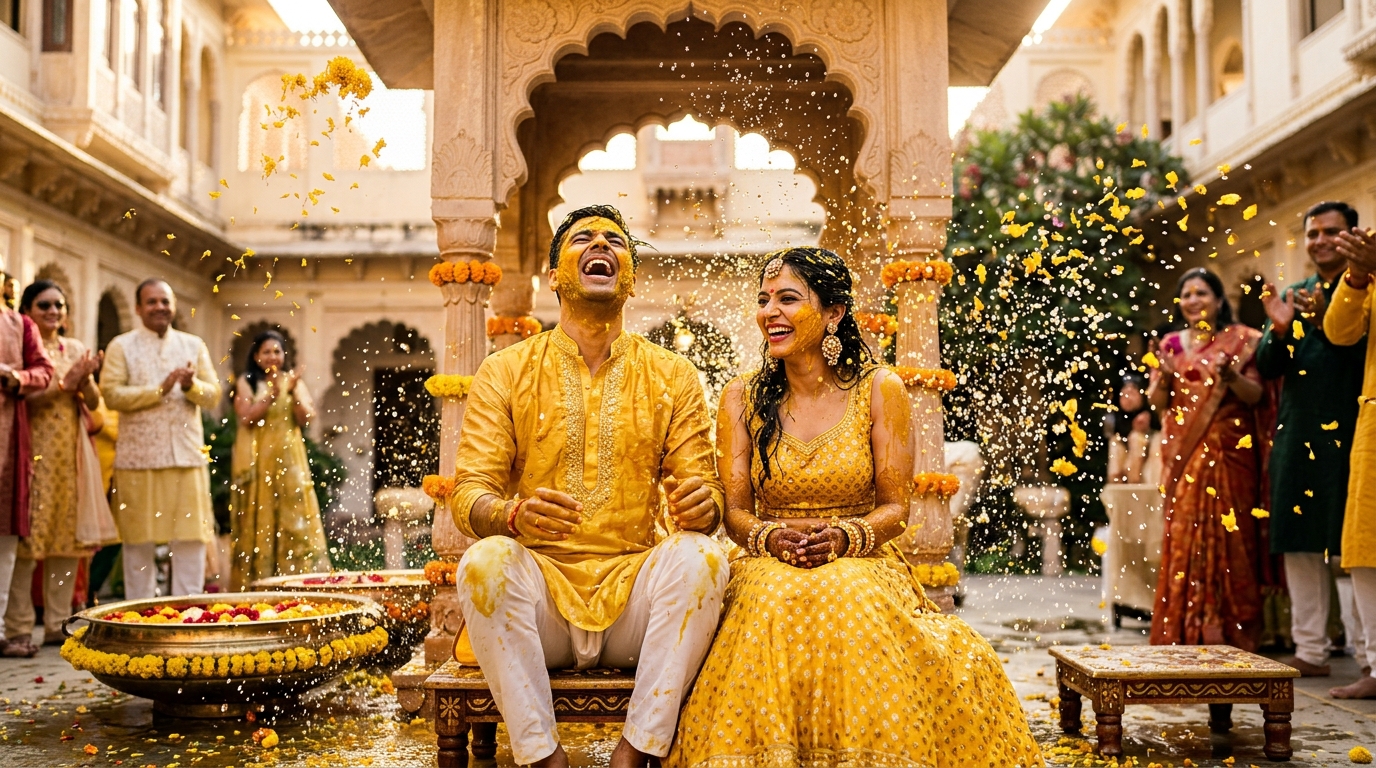
The signature moment of every modern luxury Haldi is the grand explosion: four cousins dumping steel buckets of iced turmeric water over the groom, followed immediately by dozens of guests unleashing brass bowls of fresh marigold petals. This dynamic climax lasts barely 2.5 to 3.5 seconds. If your autofocus hunts or your shutter speed is too sluggish, what should have been a viral award-winning portfolio hero shot becomes a blurry, unrecoverable yellow smudge.
To freeze airborne water beads in suspended crystal clarity while tracking the genuine emotion on the couple's faces, configure your camera bodies to these exact high-speed action metrics:
- Minimum 1/2000s Shutter Speed: A water droplet falling or flying under pressure moves at approximately 8 to 12 meters per second. A standard wedding shutter speed of 1/250s or 1/500s will render motion blur streaks across the droplets. At 1/2000s to 1/3200s, each individual droplet becomes an isolated spherical prism refracting the sun.
- Continuous AF with Human Eye/Face Subject Recognition: Modern mirrorless bodies (Sony Real-Time Eye AF, Canon Dual Pixel CMOS AF II, Nikon Deep Learning 3D Tracking) excel at human subject lock. However, flying liquid sheets and falling flower petals will frequently pass directly between the lens and the subject's face. If your autofocus tracking sensitivity is set to "Responsive" (Level 5), your AF motor will instantly jump to focus on a flying marigold petal 1 foot in front of your lens. Set your AF Tracking Sensitivity / Sticky Tracking to "Locked On" or Level 1-2. This forces the camera to ignore foreground debris and maintain lock on the groom’s eyes.
- Continuous High Burst Drive (10 to 20 FPS): Never attempt to single-shot liquid action. Set your camera to high-speed burst (mechanical or anti-distortion electronic shutter). Begin firing a half-second before the first splash makes contact, capturing the anticipatory cringe, the initial impact, and the triumphant laughter as the water cascades over the shoulders.
- CFexpress Type A/B Cards with High Sustained Write Speeds: Firing 20 FPS bursts in uncompressed 14-bit RAW generates nearly 1GB of data every two seconds. Budget V30 or V60 SD cards will choke the camera buffer mid-splash, freezing your shutter release right as the bride erupts into spontaneous laughter. Always equip your primary bodies with high-speed CFexpress or V90 UHS-II cards boasting sustained write speeds above 700 MB/s.
🎨 Section 3: Curing the "Jaundice" Trap — Color Grading Real Skin Tones Against Neon Turmeric
Perhaps the most pervasive post-production flaw in Indian wedding photography is the dreaded "Haldi Jaundice" effect. Traditional turmeric paste (Ubtan) contains high concentrations of curcumin, which emits an intense, saturated spectral reflection in the 570nm to 590nm yellow waveband. When applied to skin, it reflects yellow light back onto unaffected facial areas, making the bride and groom appear pale, sickly, or fluorescent green-yellow.
Most novice editors attempt to solve this by simply dragging down the overall Yellow Saturation slider in Lightroom. The catastrophic consequence? The beautiful marigold garlands, turmeric bowls, and yellow bridal lehengas turn muddy, desaturated khaki brown. Here is how master colorists surgically separate organic skin tones from festive yellow elements:
- Color Mixer / HSL Hue Separation: In Lightroom or Camera Raw, navigate to Color Mixer. Push the Yellow Hue slider towards Orange (+15 to +25). This shifts acidic neon yellow into a warm, appetizing golden-honey amber. Simultaneously, shift the Orange Hue slightly towards Red (+5 to +10) to anchor the hemoglobin undertones of Indian skin tones.
- Luminance Calibration: Boost Orange Luminance (+10 to +18) while keeping Yellow Luminance neutral (0 to -5). Increasing orange luminance immediately injects a healthy, radiant glow into the couple’s faces while retaining rich color depth in the turmeric paste itself.
- Targeted AI Masking (Subject Skin): Utilize Lightroom’s "Select People" AI mask. Create sub-masks for "Facial Skin" and "Body Skin". On the skin mask alone, decrease Saturation by -5 to -8, gently warm the Temperature by +3, and drop Texture by -6 to smooth out harsh sun glare on wet, glistening paste without sacrificing natural skin pores.
- Color Grading Wheel Shadow Feathering: Inject a subtle hint of cyan/blue (Hue: 215°, Saturation: 4-6) into the Shadows wheel. This neutralizes yellow color spill in dark crevices, beard hair, and fabric folds, instantly restoring photographic contrast and dimension.
🛡️ Section 4: Battle-Ready Gear Armor — Waterproofing & Protecting ₹8 Lakh Lens Rigs from Acidic Turmeric Paste
Raw turmeric is mildly acidic, highly oily, and chemically notorious for permanent staining. When mixed with water, rose water, sandalwood oil, and curd, it forms a sticky abrasive paste that can destroy precision zoom helicoids, corrode weather-sealing gaskets, and etch into front lens anti-reflective fluorine coatings if allowed to dry in the blazing sun.
Top Indian studio teams treat the Haldi splash zone with the same rigorous hazard protection protocols as a tropical rainstorm or a coastal sandstorm:
- Sacrificial Multicoated UV/Clear Filters: Never step into a Haldi event with a bare front lens element. Screw on a high-transmission multicoated protective filter (B+W, Hoya HD Nano, or Sigma WR). If a direct bucket splash strikes your lens, you can rapidly wipe down the flat glass surface with a microfibre cloth without risking scratches to the manufacturer's delicate front lens curvature.
- Silicone Armor Skins & Heavy-Duty Rain Covers: Equip your camera bodies with snug-fitting silicone protective sleeves (EasyCover) and transparent waterproof rain sleeves (Think Tank Hydrophobia or Op/Tech Rainsleeve). Secure the sleeve around the lens hood with heavy-duty gaffer tape to create a complete barrier against flying liquid and powdery turmeric clouds.
- Zoom Lens vs. Prime Lens Protocol: Avoid external-zoom lenses that telescope outward (such as a 24-70mm f/2.8) in the splash line. As the lens barrel extends and retracts, it acts as an air pump, vacuuming microscopic water droplets and turmeric dust directly past the weather seals and into the internal optical elements. Instead, utilize internal-zoom glass (e.g., 70-200mm f/2.8) or sealed primes (35mm f/1.4, 50mm f/1.2, 85mm f/1.4).
- Field Emergency Decontamination Kit: Keep an assistant stationed outside the splash zone with an emergency hygiene caddy: anhydrous isopropyl alcohol wipes (70% concentration), clean optical lens cloths in sealed zip-lock pouches, a handheld rocket blower, and a soft microfiber towel to immediately dry down moisture before it seeps into hot dial grooves.
📸 Section 5: The 5 Non-Negotiable Hero Compositions Every Luxury Indian Haldi Demands
While spontaneous documentary coverage is vital, high-paying luxury wedding clients judge your portfolio based on five signature storytelling compositions. Missing even one of these landmark moments leaves an emotional void in the final photobook:
- The Pristine Pre-Paste Editorial Portrait (15 Minutes Before Chaos): Before a single drop of turmeric touches the couple, capture a pristine, magazine-style portrait while their designer yellow outfits, floral jewelry, and immaculate hair/makeup are 100% spotless. Shoot at 85mm f/1.8 with gentle backlight.
- The Intimate Mother's Blessing (Low Angle, 50mm): Position yourself close to the brass urli bowl. As the mother gently applies turmeric paste with betel leaves or grass stalks to her child's cheeks and feet, capture the tender eye contact, tears of emotional transition, and soft smile.
- The High-Velocity Water Bucket Splash (Front-Facing Action, 35mm): Stand 7 to 8 feet away from the groom with a wide-angle 35mm lens at f/2.8, 1/2500s shutter speed. Capture the explosive radial arc of splashing water framing the groom’s roaring laughter and surrounding friends cheering.
- The Floating Phoolon Ki Haldi Shower (Overhead / Drone Perspective): Have your second shooter climb a nearby balcony or launch an aerial drone directly 90 degrees overhead. As thousands of yellow and orange marigold petals cascade from wicker baskets down onto the couple sitting in the urli, capture the symmetrical, floral kaleidoscope.
- The Post-Chaos Sunglasses Fist-Pump (Hero Finish): Drenched, covered head-to-toe in golden paste, with aviator sunglasses perched on the nose and a high-spirited smile. This is the photo that gets shared instantly across Instagram, WhatsApp Stories, and WhatsApp family groups.
⚡ Section 6: Post-Shoot Rush — Sorting 4,000 Burst Frames & Rapid Client Proofing with Pixelect
Shooting 15 to 20 frames per second across three photographers during a two-hour Haldi ceremony routinely yields between 3,500 and 5,000 RAW files. Back at the studio, this volume triggers a monumental bottleneck: sorting through hundreds of near-identical splash frames, waiting days for couples to manually write down file numbers, and spending hours manually digging through 100GB hard drives to copy selected RAWs for the wedding album.
Industry-leading studios eliminate this post-production chaos by adopting modern automated proofing workflows:
✅ Actionable 4-Step Haldi Execution Checklist
Keep this streamlined pre-shoot routine printed or bookmarked on your phone before every Indian wedding Haldi:
1️⃣ Gear Armor & Filter Inspection: Ensure all camera bodies have sacrificial multicoated UV filters firmly attached, rain covers seated over zoom rings, and backup microfiber cloths stashed in waterproof zip pouches. ✅
2️⃣ High-Noon HSS & Strobe Calibration: Test off-camera Godox/Profoto strobes at 1/1600s shutter speed with high-speed sync enabled. Confirm battery packs are fully charged and silver beauty dish is angled 45° for crisp facial catchlights. ✅
3️⃣ Camera Drive & AF Lock Configuration: Set autofocus mode to Continuous AF (AF-C), tracking sensitivity to "Locked On" (Level 1-2), and burst drive to Continuous High (12+ FPS) on CFexpress cards. Lock manual Kelvin between 5200K and 5600K. ✅
4️⃣ Instant Proofing Gallery Staging: Upload compressed preview web-resolution JPEGs to Pixelect SmartSelection immediately after the shoot. Generate a customized 4-digit client PIN and deliver it directly to the bride and groom on WhatsApp within 24 hours. ✅
❓ Frequently Asked Questions (FAQs)
Q1: How do I clean dried turmeric paste off my camera body if it slips past the rain cover?
Never use water or soap directly on camera electronics, as water will cause turmeric pigments to penetrate deeper into seams. First, allow the paste to dry completely, then gently dislodge clumps using a soft goat-hair brush and a rocket air blower. For stubborn yellow stains on rubber grips, dampen a microfibre cloth with 70% isopropyl alcohol and gently buff the surface. Avoid getting alcohol on rubber adhesive gaskets or lens front coatings.
Q2: What is the ideal focal length setup for a 2-photographer Haldi team?
The primary lead photographer should operate inside the perimeter (5 to 8 feet away) with an armored 35mm f/1.4 or 24-70mm f/2.8 lens to capture the wide environmental splash, the couple’s laughter, and surrounding crowd reactions. The second candid photographer should stay outside the splash zone (15 to 25 feet away) using a fast 70-200mm f/2.8 or 85mm f/1.4 prime to hunt for tight, emotional facial expressions, parents wiping tears, and laughing cousins dodging stray water buckets.
Q3: How does Pixelect SmartSelection save hours during large multi-thousand photo Haldi culling?
Instead of burning hours sending heavy thumb drives or wrestling with Google Drive folders where clients struggle to communicate which photos they want in their wedding album, Pixelect creates an elegant, cloud-based private gallery protected by a 4-digit PIN. The couple reviews photos seamlessly on their smartphones, tapping heart icons on their favorites. Once completed, the studio downloads a lightweight selection runner that automatically detects, filters, and copies the exact high-res RAW files from your local storage drives in just 15 seconds.
Tired of 3-Month Photo Selection Delays and Manual RAW Copying?
Deliver beautiful, high-speed mobile client proofing galleries via WhatsApp in seconds. Let your wedding couples pick their favorite Haldi and wedding album photos effortlessly on their phones, then auto-copy selected high-resolution RAWs locally in 15 seconds flat.
⚡ Try Pixelect SmartSelection Free →