⚡ Executive Summary
The Baraat is the most electrifying, unpredictable, and physically hazardous segment of an Indian wedding. With 300 to 800 guests dancing through congested streets under deafening 120dB brass bands, flying gulal, currency notes, and explosive pyro, single-shooter setups inevitably result in missed moments, crushed camera sensors, and jittery footage. This definitive masterclass outlines the field-tested 2-shooter tactical positioning blueprint, 360-degree gimbal orbits around the ghodi, night parade mobile continuous lighting techniques, gear defense protocols against fine dust, and how elite studios streamline 20,000+ chaotic Baraat RAWs in record time.
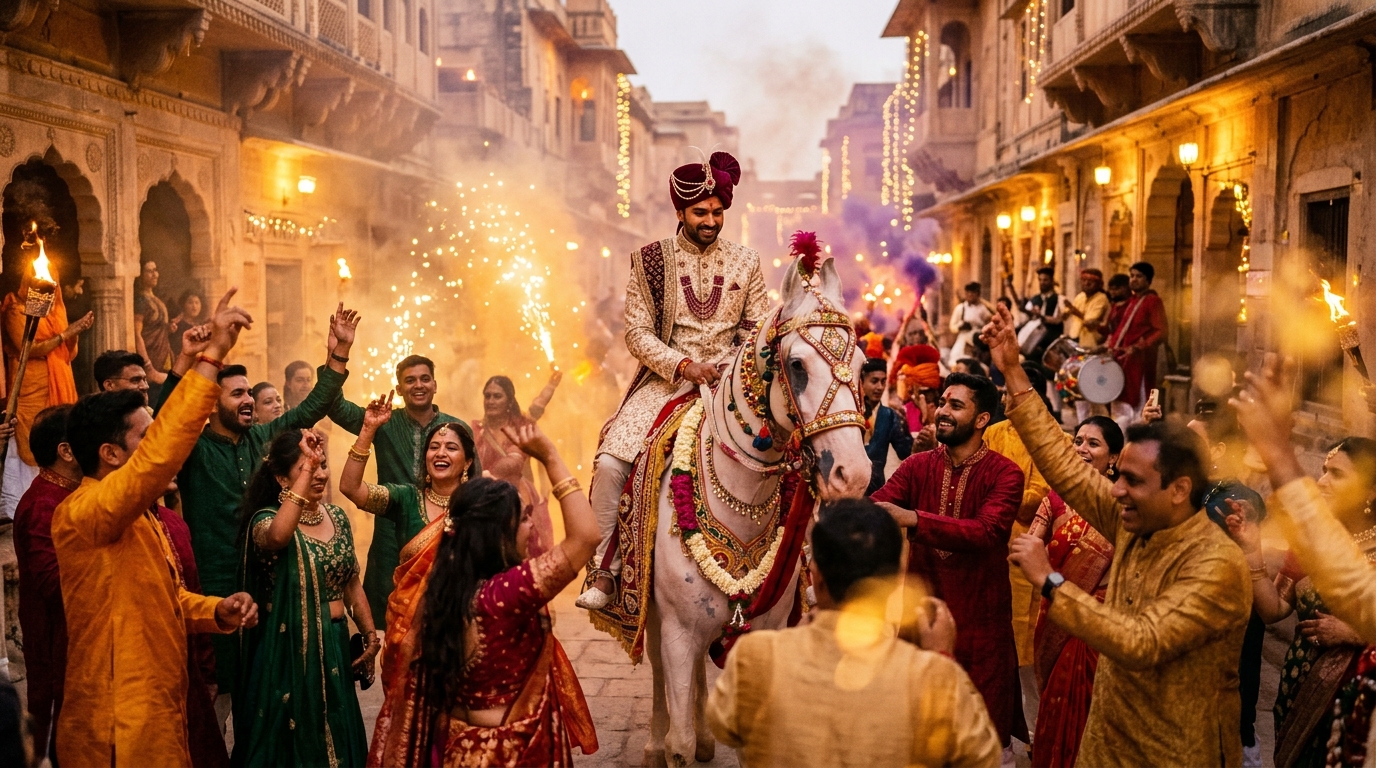
In the vibrant tapestry of Indian weddings, no ritual matches the sheer kinetic force of the Baraat. It is not a controlled ballroom processional; it is a full-throttle street festival. From the thunderous bass of competing Dhol walas and DJ trucks to the swirling clouds of colorful smoke bombs and spontaneous family dance-offs, the Baraat offers unparalleled opportunities for viral, award-winning wedding cinematography.
Yet for many wedding photo and video crews, the Baraat is also a crucible of stress. Camera bodies get jostled by enthusiastic dancers, gimbal motors overheat and fail when bumped, airborne powder cakes expensive front elements, and shifting street lighting creates nightmarish color casts. In this comprehensive masterclass, we break down the operational, technical, and creative playbooks used by India's top luxury studios to capture cinema-grade Baraat coverage safely, consistently, and flawlessly.
🥁 Section 1: The 2-Shooter Tactical Positioning Architecture
Attempting to cover a 500-person Baraat with a lone camera operator is a recipe for creative failure. When the crowd surges, a single shooter will be trapped between dancing relatives, completely blocked from the groom on his horse or vintage convertible. High-end studios deploy a strict Two-Shooter Choreography that divides perspective between ground-level immersion and elevated contextual grandeur.
1. The Ground Vanguard (Operator A — 35mm Prime / Gimbal)
Operator A operates inside the eye of the storm. Rigged with a fast 35mm f/1.4 prime lens mounted on a 3-axis motorized gimbal (such as the DJI RS3 Pro / RS4 Pro), Operator A moves backward in front of the groom's procession. The 35mm focal length offers the perfect environmental balance: it captures the groom's regal stance while preserving the peripheral frenzy of friends hoisting currency notes and dancing uncles.
2. The Aerial & Perch Observer (Operator B — 70-200mm f/2.8 or 85mm Prime)
Operator B never enters the dense crowd circle. Instead, Operator B rides atop the mobile DJ sound truck, sits in the bed of an open chase vehicle, or maneuvers on the elevated sidewalk perimeter using a 70-200mm f/2.8 telephoto zoom or an 85mm f/1.4 portrait prime. Operator B's sole mission is telephoto compression: capturing the groom laughing at his friends' antics from high above, isolated tears of joy from the groom's mother, and wide establishing ocean-of-people shots.
🐎 Section 2: Mastering the Ghodi & Vintage Car 360° Cinematic Orbits
The traditional white mare (Ghodi) or vintage open-top vehicle serves as the moving throne of the groom. Capturing dramatic cinematic moves around the groom requires specialized gimbal tuning and acute animal behavioral awareness.
1. Safe Distances and Animal Psychology
Horses are prey animals with nearly 360-degree panoramic vision, but they possess blind spots directly behind their tails and directly in front of their snouts. Sudden movements, wide camera rigs thrust toward their faces, or camera flashes popping in close proximity can cause the horse to rear or kick violently.
- Maintain a 4-Foot Buffer: Never press a wide-angle lens closer than 4 feet from the horse's flank.
- Coordinate with the Handler: Before pulling an orbit, make eye contact with the horse handler holding the reins so they steady the animal.
- Eye-Line Correction: Because the groom is seated 7 to 9 feet off the ground, shooting from chest level creates extreme upward angles that accentuate double chins and nostrils. Extend your gimbal on an monopod extension rod or stand on mobile folding step stools to raise the lens to shoulder height with the groom.
2. Executing the Parallax Orbit
Set your gimbal to Pan Follow (PF) mode with deadband set to low (2-3) and motor stiffness boosted to 65% to counteract crowd vibrations. Walk in a steady concentric circle around the horse while tilting up 15 degrees. When timed as the groom waves to an incoming cousin, the rotating background of blurred palace gates and torchlight creates pure cinematic gold.
🎆 Section 3: Taming Flying Gulal, Smoke Bombs & Pyro Haze
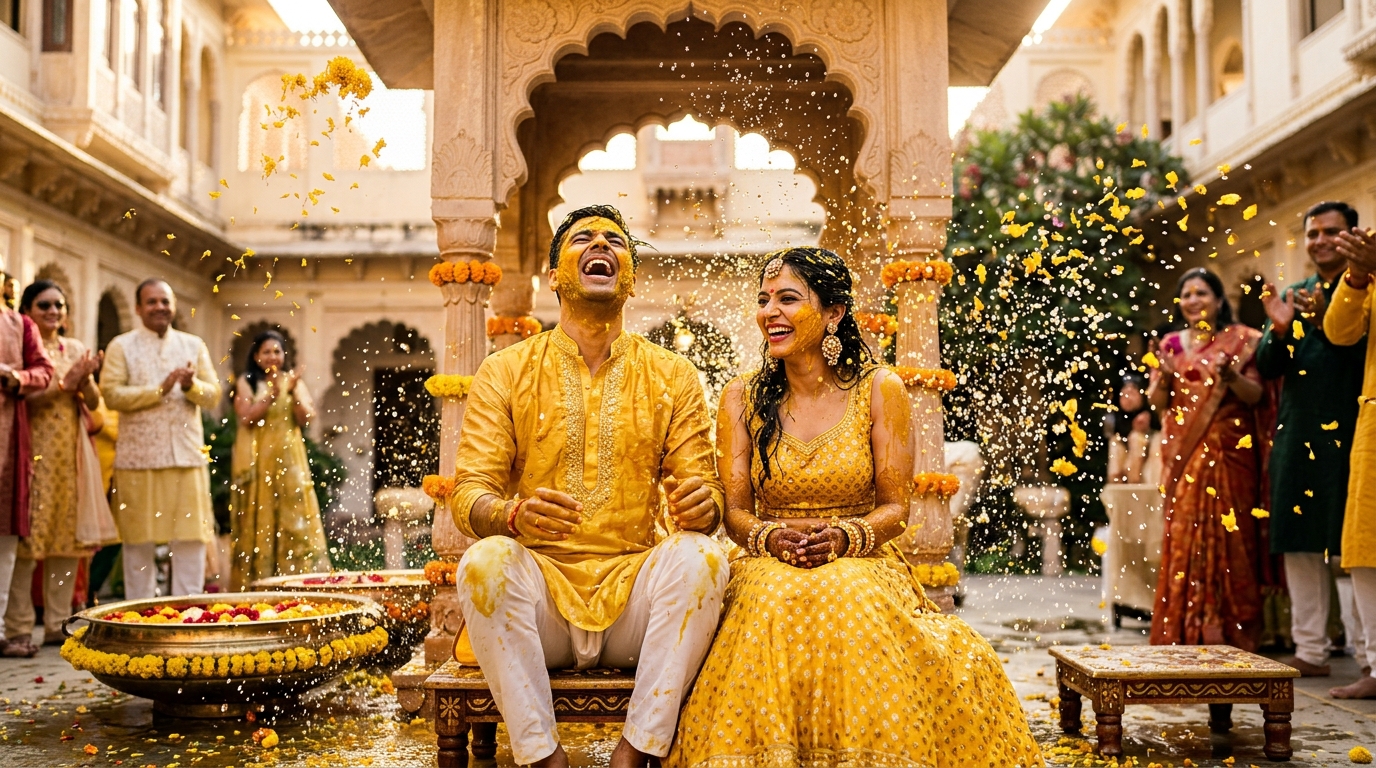
Modern Baraats frequently feature handheld colored smoke grenades (saffron, purple, crimson), confetti cannons, and dry gulal tossed into the air. While these visual elements create spectacular texture on camera, they present severe physical and optical hazards to photography gear.
1. The Triple-Layer Gear Defense Protocol
- Sacrificial UV/Protection Filters: Never shoot a Baraat with bare lens glass. Screw on a multi-coated brass UV filter. If a blast of gulal or confetti adhesive strikes the front element, you can unscrew the filter in 5 seconds rather than scratching an expensive front coating in the field.
- Silicone Gimbal Motor Sleeves & Plastic Sheaths: Fine organic starch powders find their way into gimbal arm ball bearings and camera port seams. Wrap the gimbal body with stretchable clear film, leaving only the motor axis vents clear.
- Internal Zoom Lenses Only: Never use external telescoping zooms (like 24-70mm lenses that extend physically) in dense smoke or powder. The vacuum created when zooming in draws airborne dust straight into the internal lens barrels. Stick to internal-zoom glass like 70-200mm f/2.8 or weather-sealed primes.
2. Taming Color Casts & Auto-Exposure Drifts
When a purple or orange smoke bomb pops in front of your lens, camera auto-white-balance (AWB) goes completely haywire. An orange smoke cloud causes AWB to swing aggressively into icy blue, turning the groom's skin a sickly turquoise. Lock your camera's White Balance manually to 5600K (Daylight) during twilight Baraats or 3800K-4200K for nighttime torchlit street parades. Never allow the camera processor to guess Kelvin color in real time.
💡 Section 4: Night Street Parade Lighting: Mobile Handheld Rigs vs High-Power Strobes
Indian Baraats typically begin in late afternoon golden hour and stretch 3 to 4 hours into pitch-black night. Once the sun dips below the horizon, standard street lamps provide horrible blotchy yellow sodium vapor light (CRI under 60) that ruins skin tones.
1. The 12-Foot Monopod "Boom-Stick" LED Technique (For Video)
Rather than mounting a blinding continuous light directly on top of the camera (which creates flat, washed-out forensic lighting), top cinematographers equip an assistant with a high-CRI (97+) bi-color LED tube light (such as the Godox LC500R or Nanlite Pavotube II) mounted on a 10-to-12-foot carbon fiber boom pole with a 45-degree honeycomb grid.
The assistant walks 8 feet to the right or left of the operator, angling the soft directional light down onto the groom at a 45-degree angle. This creates flattering butterfly or Rembrandt lighting, carves out jawlines, and keeps the light completely off the camera lens to prevent flare.
2. High-Speed Sync (HSS) Off-Camera Speedlights (For Stills)
For still photographers freezing fast Bhangra jumps and flying currency notes, a single on-camera flash with a magnetic dome diffuser (e.g., Godox V1 Pro with AK-R1 dome) set to TTL with -0.7 EV compensation provides gentle fill. Meanwhile, a mobile second shooter carries a Godox AD200 Pro II on a painter's pole set to 1/16th power, creating a crisp rim light behind the dancers that separates their dark silhouettes from the nighttime street background.
📊 Section 5: The Old Manual Baraat Shooting vs Modern Pixelect Studio Workflow
A typical 4-hour Baraat produces anywhere from 6,000 to 12,000 photo and video clips across 3 to 4 shooters. Here is how outdated manual studios stumble compared to modern, automated digital studios:
✅ Section 6: The 4-Step Baraat Day-of Checklist for Elite Wedding Crews
Print this operational checklist or save it on your crew WhatsApp group before stepping out onto the street:
✅ Screw on sacrificial multi-coated brass UV filters on all lenses.
✅ Tape battery door seams and wrap gimbal axis arms with protective stretch film.
✅ Equip every camera with dual V90 SD cards writing in redundant mirror mode.
✅ Supply high-fidelity acoustic earplugs (15-20dB attenuation) for all operators standing near Dhol drums.
✅ Clamp 32-bit float audio recorders (e.g., Zoom F2 or Tentacle Track E) with deadcat windscreens onto the DJ truck and the groom's sherwani collar.
✅ Station Operator B with a 70-200mm f/2.8 lens on the DJ truck bed with a secure safety harness.
✅ Establish two-way walkie-talkie communication between Operator A on the ground and Operator B on the perch.
✅ As soon as the Baraat reaches the venue gates, ingest SD cards into the on-site Rugged NVMe drive.
✅ Run Pixelect SmartSelection to generate lightweight preview sets and send the groom's family an instant WhatsApp teaser link within 2 hours of arrival.
❓ Section 7: Frequently Asked Questions (Baraat Cinematography & Gear)
Q1: How do you prevent gimbal motors from burning out when bumped in crowded Baraats?
Always balance your camera rig with precision before turning the gimbal on—imperfect mechanical balance forces motors to draw peak current to stay level. When people bump into the gimbal arms, the sudden resistance causes motor slippage and overheating. Keep motor stiffness around 65-70% rather than 100%, and instruct your spotter to push away aggressive dancers before they make contact with the rig. If the gimbal vibrates rapidly, double-click the trigger to re-center immediately.
Q2: What is the optimal shutter speed for capturing flying currency notes and fast dancing?
For still photography, set your shutter speed to at least 1/500s or 1/800s. Indian dancing features rapid hand gestures and jumping; anything slower than 1/320s will introduce noticeable motion blur in fingers and flying currency notes. For cinematography, switch your camera to 50fps or 60fps at 1/100s or 1/120s shutter speed. This allows you to slow down the frenetic action by 50% in post-production, transforming chaotic dancing into a lyrical, emotional Bollywood spectacle.
Q3: How do top studios avoid spending days sorting thousands of duplicate Baraat burst shots?
Because high-speed bursts generate 5,000+ images per Baraat, manual photo culling in legacy desktop apps can take up to 2 weeks. Leading Indian studios upload web-optimized JPGs directly into Pixelect SmartSelection. The couple and their families can review and select their favorite Baraat portraits from their phones using a simple 6-digit WhatsApp PIN. Once selected, Pixelect's 1-Click Local RAW Auto-Copy instantly identifies and copies the matching multi-camera RAW files on the studio's local workstation in 15 seconds flat.
Never Manually Search 20,000 Baraat RAWs Again
Stop letting massive wedding photo batches stall your album delivery. With Pixelect SmartSelection, give clients instant WhatsApp PIN mobile galleries for friction-free photo selection, and auto-copy all chosen high-res RAW files on your local editing PC in just 15 seconds.
Start Free on Pixelect →