Executive Summary & Studio Takeaway
The Vidaai (Bidai / Doli) is the emotional soul of an Indian wedding—yet it remains the single most challenging technical assignment for wedding photographers. Unfolding between 2:00 AM and 5:00 AM in pitch-black hotel driveways, dim tented lawns, or narrow ancestral verandas, it combines raw grief, rapid physical movement, unpredictable car departures, and sudden lighting drop-offs. Blasting high-power on-camera flashes destroys the sacred intimacy and blinds sobbing parents, while shooting purely ambient yields grainy, motion-blurred mush. This masterclass reveals how elite Indian wedding studios use feathered 3200K continuous LED wands, dual-operator rim lighting, circular polarizers for car windows, high-ISO low-noise sensor profiling, and friction-free post-production with Pixelect to deliver tears of joy instead of missed moments.
Ask any veteran Indian wedding cinematographer or candid photographer about their most anxiety-inducing segment of a 3-day luxury wedding, and the answer is rarely the grand Baraat or the chaotic Sangeet. It is almost unanimously the Vidaai.
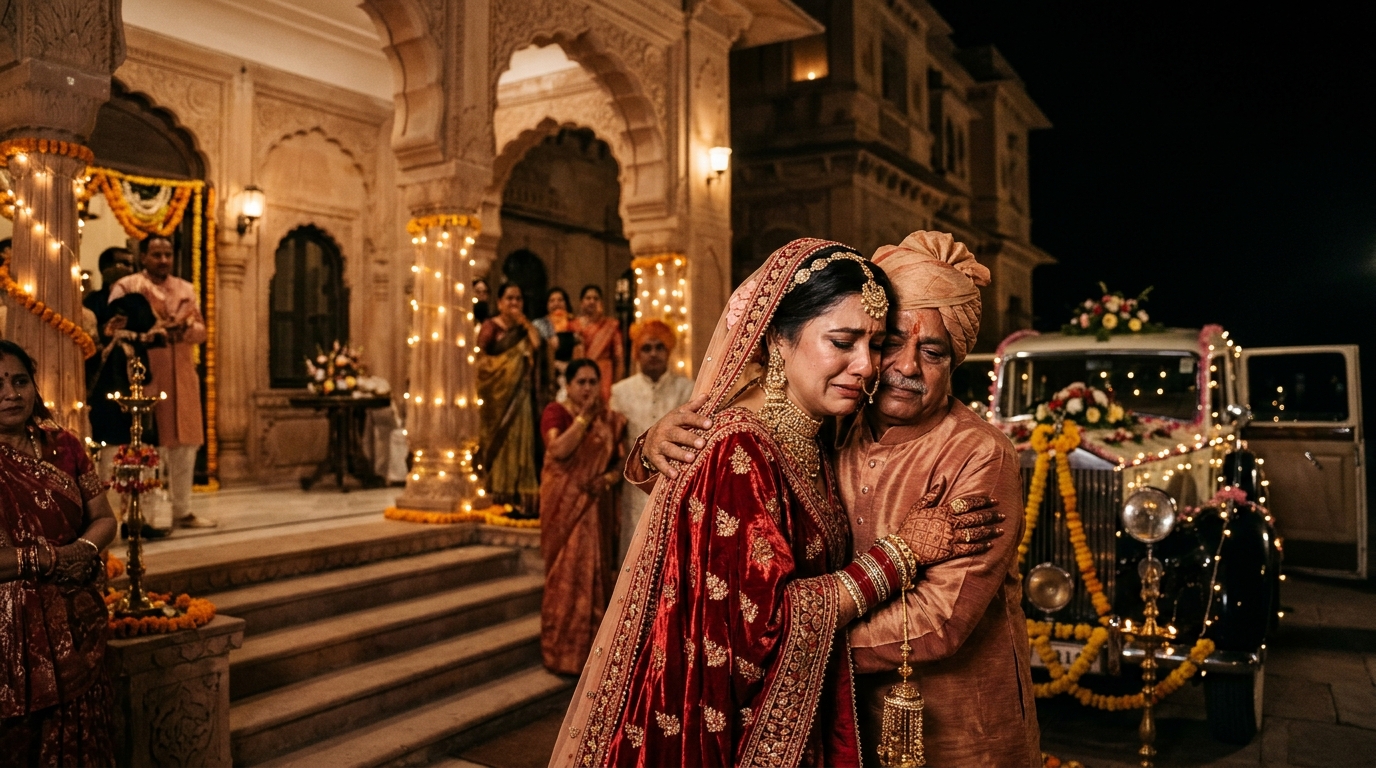
Unlike a choreographed Varmala on a hydraulic stage with synchronized cold pyro, the Vidaai is completely unscripted, intensely intimate, and physically chaotic. At 3:30 AM, when both families are physically exhausted and emotionally vulnerable, the bride steps out of the Mandap. She throws puffed rice over her head into her mother's outstretched saree pallu, embraces her weeping father, hugs her siblings in uncontrollable tears, and steps into a waiting getaway car before pulling away into the night.
If you fire a 1/1 full-power speedlight directly into the bride's tear-soaked eyes, you commit the ultimate professional sin: you rupture the emotional sanctuary of the moment, distract the family, and produce flat, harsh, overexposed snapshots with pitch-black backgrounds. Conversely, if you rely entirely on ambient lawn lights (which are often sodium vapor streetlights or dim yellow halogens mixed with blue security LEDs), your shutter speed drops to 1/60s, producing soft, unusable frames plagued by motion blur and muddy skin tones.
In this definitive 2026 masterclass, we break down the exact technical, psychological, and lighting frameworks deployed by India's top wedding studios to document the Vidaai with Hollywood-grade cinematic elegance, respect, and razor-sharp precision.
🌙 1. The Anatomy of Pitch-Black Vidaai Lighting: Why Direct Speedlights Fail
To conquer the Vidaai, you must first understand the physics of inverse-square falloff in dark outdoor spaces. When shooting inside a banquet hall, bounced flash works because white plaster ceilings and marble floors recycle scattered photons. Outdoors in an open courtyard, driveway, or lawn at 3:00 AM, there is zero bounce surface. Any light emitted from an on-camera flash travels directly forward, illuminates the subject with clinical harshness, and falls off into absolute darkness within six feet.
Furthermore, Indian bridal makeup at the end of an 8-hour wedding involves layers of setting powder, highlighter, sweat, and genuine tears. Direct on-camera flash creates specular white glare on oily foreheads and reflective teardrops, completely blowing out skin highlights and washing out intricate zardozi embroidery on red and maroon velvet lehengas.
Top-tier studios have abandoned on-camera flash during Vidaai in favor of a Hybrid Feathered Lighting Architecture. This setup combines two ultra-lightweight, high-CRI continuous LED tube lights (such as the Aputure Amaran T2c, Godox TL60, or Zhiyun Fiveray V60) mounted on handheld carbon-fiber boompole monopods held by trained second shooters.
💡 2. The 2-Light Mobile Wand Rig: Key Light Feathering & Warm Rim Separation
How do award-winning wedding teams create that three-dimensional, magazine-cover separation during night send-offs? They implement the Mobile Orbit Lighting Framework.
Instead of static light stands—which are dangerous trip hazards in a milling crowd of weeping relatives and moving luggage—your second shooter moves dynamically with an LED wand equipped with a 45-degree honeycomb grid. Here is the operational breakdown:
- Light #1: The Feathered 3200K Key Wand (Lead Assistant): Positioned at 45 degrees to the bride's side, elevated 7.5 feet high, and aimed slightly in front of the bride rather than directly at her face. By "feathering" the edge of the light beam, the softest falloff kisses her cheekbones, illuminating tears with a soft amber sheen while maintaining deep, flattering shadow transitions across her cheeks. The color temperature is dialed precisely to 3100K–3300K with a CRI/TLCI >97, matching the warm romantic glow of vintage palace brass lanterns.
- Light #2: The Kicker / Rim Accent (Second Assistant / Floater): Positioned 15 to 20 feet behind the bride and her father, angled downward at 60 degrees. This light is set to 3800K at 25% power. It catches the rim of the bride's sheer georgette dupatta, the texture of the groom's sherwani, and airborne dust or flower petals, carving the subjects out from the pitch-black night backdrop with a luminous halo.
- Camera Synchronization: Both lead photographer and candid second shooter shoot wide open at f/1.4 or f/1.8. Because the continuous LED wands provide constant, flicker-free illumination, both photographers and cinematographers can shoot simultaneously without firing strobe pops that ruin the cinematic video capture!
📸 3. Camera Bodies, Fast Primes & Low-Light Exposure Formulas
Modern full-frame mirrorless sensors (Sony BSI Exmor R, Canon Dual Pixel CMOS AF II, and Nikon Z stacked sensors) have transformed low-light wedding photography. However, gear alone will not save you if your exposure triangle is improperly balanced. Here are the battle-tested camera settings for high-stakes Vidaai coverage:
- Lens Weapon of Choice — 85mm f/1.4 or 50mm f/1.2 Primes: Do not use f/2.8 zoom lenses like the 24-70mm during Vidaai unless you have massive off-camera stadium lighting. An 85mm f/1.4 GM (Sony) or RF 85mm f/1.2L (Canon) lets in four to six times more light than an f/2.8 zoom. More importantly, the razor-thin depth of field beautifully obliterates chaotic background clutter—hotel staff loading trolley bags, banquet security guards, and plastic water bottles—transforming background streetlights into creamy golden orbs of bokeh.
- Shutter Speed Threshold — 1/250s Minimum: Even though the bride is walking slowly, sudden emotional hugs, quick hand gestures, and trembling shoulders cause micro-blur. Never drop below 1/200s or 1/250s during the walking farewell.
- Dual-Base ISO Utilization: On modern cameras like the Sony A7 IV (second base ISO 3200), Sony FX3 / A7S III (base ISO 12,800), Nikon Z8 (dual gain ISO 4000), or Canon R6 Mark II, do not fear high ISOs. Shooting at clean ISO 3200–6400 with proper exposure in the shadows yields far cleaner results in post-production than underexposing at ISO 1600 and lifting shadows by +2.5 EV later.
- Electronic Shutter & Silent Shooting: Ensure your camera is set to silent or soft electronic mechanical shutter. The repetitive clacking of mechanical mirrors or loud shutters in a quiet, tearful room can make grieving family members deeply uncomfortable.
🚗 4. Conquering the Getaway Car: Reflections, Tinted Glass & Polarizers
The climax of the Vidaai occurs when the bride enters the rear seat of the getaway car (often an Audi, Mercedes, BMW, or decorated vintage car), rolls down the tinted glass window halfway, and extends her hand to wave her final goodbye. This is where 90% of amateur wedding photos fall apart.
The moment the bride sits inside the vehicle, ambient light plummets by 4 stops. Car interiors are dark leather or velvet, absorbing nearly all light. Worse, windshields and passenger windows reflect exterior streetlights, phone screens of surrounding guests, and photographers' own reflections.
To conquer the car send-off:
- Equip a High-Transmission Circular Polarizer (CPL): A quality slim CPL (B+W XS-Pro or PolarPro QuartzLine) cuts through automotive glass reflections with a simple 45-degree twist, allowing the viewer to clearly see the bride’s face through the car window.
- The Passenger-Side Interior Light Hack: Before the bride sits down, have your assistant open the opposite rear door (or front passenger door) and place a tiny magnetic cube light (such as an Aputure MC or Zhiyun Molus G60 with diffusion silicone dome) set to 3200K at 5% power on the floorboard or dashboard, aimed upwards into the vehicle ceiling. This fills the interior with a soft, natural ambient warmth that makes the car look like a cinematic movie set.
- The Exterior Silhouette Backlight: As the car rolls forward, position a wireless speedlight or continuous LED tube behind the rear tires or held high behind the trunk. The backlight outlines the flowers on the car boot and illuminates the waving hand through the rear windshield.
⚖️ The Workflow Comparison: Old Manual Coverage vs. Modern Pixelect Standard
Capturing high-ISO Vidaai photographs is only half the battle. Delivering them quickly without burning hours in manual file segregation and client confusion is what defines high-profit modern studios. Here is how leading studios upgrade their workflow:
| Workflow Dimension | The Old Manual Studio Way | The Modern Pixelect Way |
|---|---|---|
| Lighting & Ambience | Harsh on-camera speedlights blinding clients; black background falloff; harsh blown highlights. | Feathered 3200K continuous LED wands + warm rim separation; cinematic low-light depth. |
| Car Window Reflections | Blown reflections of phone screens & flash heads obscuring the bride's face. | Rotated high-transmission CPL filters + subtle warm interior footwell fill. |
| RAW Culling & Proofing | Dumping 1,200 RAW bursts onto slow Google Drive links; bride waits weeks while crying photos linger. | Instant WhatsApp PIN galleries via Pixelect; couple proofs raw selections from mobile in 15 minutes. |
| Post-Selection RAW Extraction | Editor spends 4 agonizing hours manually hunting filenames (DSC09812.ARW) across 15 SD cards. | 1-Click Local RAW Auto-Copy moves all client-selected frames into an edit folder in under 15 seconds! |
📋 5. The 4-Step Actionable Vidaai Deployment Checklist
Before the Pandit wraps up the Saptapadi and announces the impending departure, execute this foolproof pre-departure checklist:
- 1️⃣ Pre-Position the Getaway Vehicle & Path Clearance: ✅ Ensure the car engine is running, interior dome lights are turned OFF, windshields are wiped clean with a microfiber cloth, and your path from the mandap exit to the car door is free of cable snags and luggage trolleys.
- 2️⃣ Calibrate Light Wands to 3200K at 20% Output: ✅ Set your mobile LED tube wands to warm tungsten balance, attach the honeycomb grid to prevent spill into the crowd, and brief your assistants on the 45-degree orbit technique.
- 3️⃣ Switch to Fast 85mm Prime & Eye AF Burst Mode: ✅ Mount your f/1.4 prime, dial your shutter speed to 1/250s, open aperture to f/1.6, set Dual Native ISO to 3200/6400, and enable Continuous Low Burst (5-7 fps) with silent electronic shutter.
- 4️⃣ Upload Teaser Proofs to Pixelect WhatsApp Gallery in 24 Hours: ✅ Pick 25 poignant Vidaai highlights, color grade them with warm cinematic grain, and deliver them through a secure branded WhatsApp PIN link to ignite viral family referrals.
❓ Frequently Asked Questions (FAQs)
Q1: What if the venue has chaotic mixed fluorescent green and pink floodlights at the porch?
Do not try to overpower massive fluorescent venue floodlights with flash, as this creates hideous color fringe banding. Instead, instruct your lighting assistant to bring the 3200K continuous wand within 4.5 feet of the bride to establish your warm key light as the dominant exposure on her face. In Lightroom, use the AI Subject Mask tool to warm the couple’s skin tones while desaturating harsh fluorescent greens (-25% Saturation on Green/Aqua) in the background.
Q2: How do you prevent auto-focus hunting when the bride is crying behind a heavy veil?
Heavy bridal veils with stone borders can fool mirrorless Face/Eye AF algorithms into focusing on the lace netting instead of the pupil. Switch your autofocus area mode from "Wide / All Area" to "Tracking Spot (Small or Medium)". Place the target pin directly over the bride’s visible iris or tearline. Your continuous LED wand provides the steady contrast edges needed for the camera's phase-detection points to lock securely without hunting.
Q3: Should we shoot Vidaai in Black & White or Full Color?
Always shoot in uncompressed RAW in full color! In post-production, black-and-white conversions with deep contrast (Tri-X or Ilford HP5 style tonal curves) work magnificently for tearful tight portraits because they eliminate distractions caused by mismatched guest clothing colors. However, for the walking farewell showing the rich crimson bridal lehenga and floral garland send-off, full warm color grading preserves the cultural majesty of the moment.
Stop Wasting Hours Hunting Selected RAW Files
When couples choose their favorite Vidaai and wedding highlights, why should your editing team spend four exhausting hours hunting DSC file numbers across external hard drives? With Pixelect SmartSelection, send clients secure 6-digit WhatsApp PIN galleries and extract all selected RAW photos onto your edit drive in under 15 seconds with 1-Click Local Auto-Copy!
🚀 Experience 1-Click Local RAW Auto-Copy Free →