Executive Summary & Studio Takeaway
The grand Indian wedding reception stage is the ultimate technical proving ground for professional wedding studios. Between harsh banquet ceiling downlights casting unflattering dark eye shadows ("raccoon eyes"), complex 15-person family groups causing severe edge falloff, reflective gold zari embroidery, and rapid-fire queues of 800+ guests over 4 exhausting hours, relying on on-camera bounce flash is a recipe for amateur results. In this definitive 2026 masterclass, we break down the battle-tested 3-to-4 light Off-Camera Flash (OCF) architecture, Inverse Square Law formulas for wide group portraits, thermal throttling survival strategies for Godox strobes, and how leading studios eliminate post-reception proofing bottlenecks in 15 seconds with Pixelect.
💡 The Anatomy of the 4-Hour Indian Reception Stage Nightmare
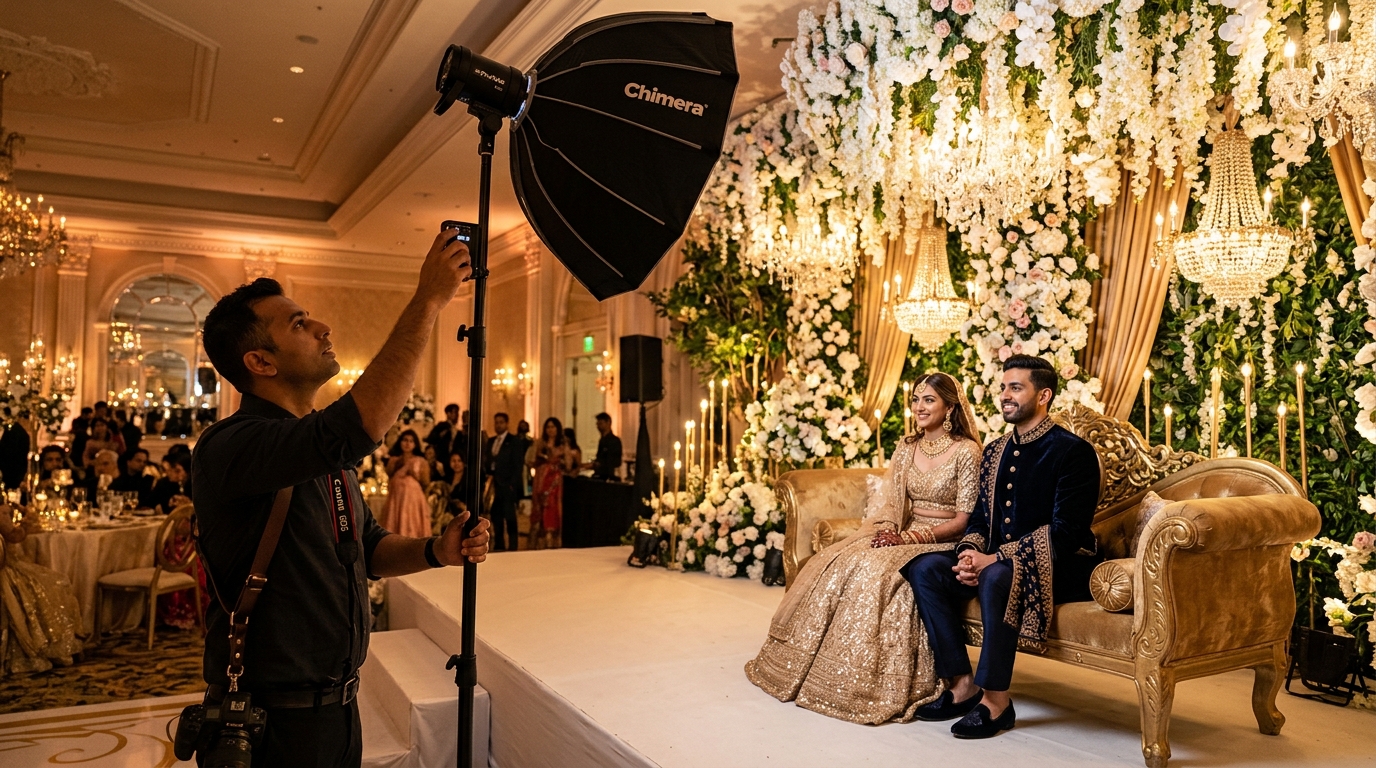
If you ask any seasoned Indian wedding photographer to name the single most physically demanding and technically punishing phase of a three-day celebration, the answer is rarely the Baraat or the Mandap. It is the formal Reception Stage Marathon. Over the span of three to five relentless hours, a single lead shooter must photograph between 600 and 1,500 guests as they greet the newlywed couple on a brightly decorated raised stage.
While this might appear routine to an untrained amateur, professional studios understand that banquet hall stages present a minefield of optical, electrical, and physical challenges that routinely ruin client deliverables:
- The "Raccoon Eyes" Phenomenon: Modern luxury banquet venues install aggressive 50W LED downlights directly above the stage sofa. These overhead spotlights cast pitch-black shadows directly beneath the eyebrows, nose, and chin, aging the bride and groom by twenty years.
- Severe Edge Falloff in Large Groups: When a joint family of twelve to fifteen relatives lines up on stage, an on-camera flash or narrow light modifier blasts the center couple with blinding light while leaving the elders and cousins on the outer flanks one to two stops underexposed and muddy.
- Blown Highlights on Zari and Sequin Fabrics: Luxury Indian bridal couture features real gold zardozi, metallic threadwork, polished Kundan, and diamond sets. Point-blank direct flash turns these exquisite hand-embroidered textures into blown-out, pure white specular blowouts devoid of detail.
- Flash Thermal Throttling: Firing a compact speedlight or portable strobe every eight seconds for four hours straight rapidly triggers thermal protection locks. When your flash freezes and shows an overheating error during the entrance of an essential VIP dignitary, your studio reputation takes a permanent hit.
⚡ The 3-to-4 Light Off-Camera Flash (OCF) Architecture for Grand Stages
To produce consistent, magazine-cover quality stage portraits that command premium ₹2.5 Lakh+ package rates, top Indian studios ditch on-camera flashes and construct a dedicated, repeatable Off-Camera Flash (OCF) rig. Whether you are shooting in a 5,000 sq ft hotel ballroom or a sprawling 20,000 sq ft convention lawn, this modular 3-to-4 light configuration guarantees razor-sharp, evenly balanced exposures across every single group.
1. Key Light: Main Directional Source (Godox AD400 Pro or AD600 Pro)
Position your primary key light at a 30-degree angle from the camera-to-stage axis, elevated to 9.5 or 10 feet on a heavy-duty C-stand with sandbags. Equip this strobe with a 48-inch to 60-inch Deep Parabolic Softbox with double diffusion and grid. The large modifier provides a wrapping, buttery-soft light that fills in harsh overhead ceiling downlights, completely eliminating dark eye circles while preserving delicate skin tones and natural contouring.
2. Fill Light: On-Axis Shadow Lifter (Godox AD200 Pro II or V1 Pro)
Positioned directly beside or slightly above the camera lens axis, set at approximately 1.5 to 2 stops lower than the main key light (e.g., if Key is f/8, Fill is f/4.5). Equipped with a 36-inch white umbrella or diffusion dome, the fill light ensures that deep neck shadows and fabric folds are cleanly lifted without introducing distracting secondary catchlights in the subjects' pupils.
3. Twin Rim/Hair Kickers: Stage Separation (Godox AD200 Pro / AD300 Pro)
Tucked inconspicuously behind the stage sofa or hidden behind floral pillars on both far corners of the stage riser, aim these strobes forward and diagonally toward the couple's backs and shoulders at a 45-degree angle. Add honeycomb grids or barn doors to prevent lens flare into your primary camera. These kickers create a razor-sharp golden rim along the bride's dupatta, hair, and the groom's sherwani collar, creating dramatic 3D visual separation from intricate flower walls.
📐 Inverse Square Law Mastery: Solving the 15-Person Family Group Falloff
The cardinal law of photographic physics that separates master wedding photographers from frustrated amateurs is the Inverse Square Law: Light intensity falls off exponentially with the square of the distance from the source. When a light modifier is placed only 6 feet away from the center couple, moving just 3 feet outward to the edge of a wide family line cuts the light intensity by more than 50% (over 1 full f-stop of underexposure).
To master massive 12 to 18-person stage lineups, implement the Feathered Distant Source Technique:
- Back the Light Away: Move your primary key light stand back to 14–18 feet from the center of the stage. Because the distance ratio between the center couple (15 feet) and the outer edges (17 feet) is now minimal, the light falloff across the entire 15-person width is less than 0.2 EV, creating flawless, edge-to-edge uniform brightness.
- Feather Across the Front Line: Rather than aiming the center hot-spot of your softbox directly at the bride and groom, aim the center of the modifier slightly forward into the empty floor space in front of the stage. The feathered edge of the beam gently washes the couple, while the fuller beam covers the wider flanks.
- Camera Exposure Settings: Lock your camera in Full Manual mode. A benchmark setting for high-end reception stages:
- Aperture: f/6.3 to f/8.0 (Crucial to ensure razor-sharp focus from the front row seated grandparents to the third row standing cousins).
- Shutter Speed: 1/160s to 1/200s (Freezes subtle micro-movements, handshakes, and clapping without hitting mechanical sync limits).
- ISO: ISO 400 to 800 (Allows your strobes to fire at 1/8th or 1/16th power, ensuring sub-second recycle times and preventing thermal shutdown).
🔥 Strobe Thermal Survival: Shooting 1,200 Consecutive Pops Without Shutdown
During peak muhurat dates in November, December, and February, indoor banquet halls packed with 800 attendees frequently suffer from failing air conditioning, with ambient temperatures climbing above 32°C (90°F). If your lights are firing at 1/2 or full power, compact lithium batteries will overheat within 200 shots, triggering flashing thermal icons and forcing a 20-minute shutdown.
Follow these elite studio engineering protocols to keep your flash heads cool and operational throughout the longest Indian reception marathons:
- Leverage the ISO 800 Sweet Spot: Never shoot reception stages at base ISO 100. Modern BSI full-frame sensors (Sony A7 IV, Nikon Z8, Canon R6 Mark II) produce virtually zero visible chroma noise at ISO 640–800. Bumping your camera from ISO 100 to ISO 800 reduces your required flash power by three full stops (e.g., from 1/2 power down to 1/16 power). At 1/16 power, Godox AD200 Pro II and AD300 units can fire 2,000 shots continuously without thermal distress.
- Equip Dedicated Bare-Bulb Heads: If using Godox AD200 or AD200 Pro systems, swap out the fresnel speedlight head for the bare-bulb flashtube head inside your softbox. Bare-bulb heads dissipate heat directly into the ambient air, whereas closed fresnel heads trap heat in the front plastic fresnel element, causing rapid heat buildup.
- Dual-Battery Rotation System: Keep three extra chilled lithium batteries in an insulated bag. Swap your strobe batteries proactively at the 2-hour mark (during the buffet break) before they reach peak thermal saturation.
🎨 Ambient Harmony & Color Temperature: Taming Mixed Banquet Lighting
One of the most frequent amateur flaws seen in reception stage galleries is muddy, conflicted color: cool, blue flash on the couple's faces paired with sickly, radioactive orange tungsten light from the chandelier ceiling, or neon magenta spill from stage uplights.
To achieve the rich, golden, high-end commercial aesthetic demanded by luxury Indian clients:
- Gel Your Strobes with 1/4 or 1/2 CTO: The ambient lights in grand Indian wedding banquets typically measure between 3000K and 3600K. Bare photographic flash fires at a cool daylight 5600K. Affixing a MagMod or magnetic 1/4 CTO (Color Temperature Orange) gel to your key and fill strobes drops their color temperature to roughly 4200K–4500K.
- Lock In-Camera Custom Kelvin: Dial your camera's white balance manually to 4300K–4600K. When your strobes and camera Kelvin are harmonized, the bride's complexion renders warm, golden, and glowing, the groom's navy or black suit remains deep and neutral, and background chandeliers render as pleasing golden accents rather than glaring neon orange pools.
- Flag Unwanted Stage Washes: If the banquet decorator has positioned garish RGB wash lights pointing straight at the sofa, politely speak with the venue electrician or decorator 30 minutes before the couple's arrival and ask them to switch stage perimeter lights to warm incandescent amber or soft neutral white.
📊 The Studio Workflow Evolution: Old Manual Way vs. The Modern Pixelect Way
Capturing 1,200 pristine stage portraits is only half the battle. How your studio processes, culls, and delivers these monumental files to the couple and their extended families determines your client satisfaction, referral velocity, and cash flow.
🚀 The 4-Step Indian Reception Stage Execution Checklist
Print this battle-tested checklist or save it on your smartphone to ensure your entire camera and lighting team executes flawlessly before the bride and groom take their first step onto the reception riser:
1️⃣ Stage Geometry & Ambient Audit: Measure stage height, sofa positioning, and ceiling clearance. Identify overhead downlights directly above the seating area. Ask venue management to dim harsh spotlights or adjust color temperature to warm white. ✅
2️⃣ 3-Point Light Rig Deployment: Position Key Light (60-inch softbox on C-stand with 10kg sandbag) at 30 degrees, 15 feet back. Position on-axis Fill Light at camera position. Mount twin gridded rim strobes behind the stage corners angled toward the couple's shoulders. ✅
3️⃣ Exposure & Thermal Calibration: Set camera to Manual Mode: 1/160s, f/7.1, ISO 800, Custom Kelvin 4400K. Adjust Key strobe to 1/16th power, Fill strobe to 1/64th power, and Rim strobes to 1/32th power. Test shoot with an assistant sitting on both the sofa center and outer edges to confirm zero falloff. ✅
4️⃣ Rapid Delivery Pipeline Prep: Pre-configure your Pixelect Smart Selection event gallery before the wedding. Ensure your studio logo, WhatsApp PIN automation, and local storage folders are primed to receive stage JPEGs immediately after backup. ✅
❓ Frequently Asked Questions (FAQs)
Q1: What should I do if the banquet hall ceiling has uncontrollable colored LED wash lights?
If the venue DJ or decorator cannot turn off rogue magenta or blue wash lights hitting the couple, overpower the ambient contamination using your flash-to-ambient ratio. Increase your shutter speed to your camera's maximum sync speed (typically 1/200s or 1/250s) and step down your aperture to f/8 while boosting your strobe output slightly. This suppresses ambient room spill by 2 stops, leaving your clean, CTO-gelled flash as the dominant illuminating source on the couple's faces.
Q2: Can I use continuous video LED lights instead of strobes for reception stage photos?
While continuous LED wands and COB lights are great for video teams, they are vastly underpowered for large group portraits. To get f/7.1 depth of field at 1/160s across a 15-person group, continuous lights would need to be blindingly bright (over 600W COBs), causing extreme eye fatigue and squinting for the bride and groom over four hours. Flashes produce immense instantaneous output without blinding your subjects between exposures.
Q3: How do I handle guests who constantly take smartphone photos with flash, ruining my lighting?
Smartphone flashes and guest speedlights use optical pulses that can prematurely trigger older optical slave strobes. Always operate your off-camera lighting using secure 2.4GHz digital radio triggers (such as the Godox X3, XPro II, or X2T) set with a custom Radio ID (01-99). This completely isolates your strobes from interference caused by guest phones or other banquet photographers.
Stop Wasting 6 Hours Manually Searching RAW Stage Files
After shooting 1,200 flawless reception stage portraits, the last thing your studio needs is an endless back-and-forth WhatsApp nightmare and hours spent manually matching client-selected filenames. Upgrade your studio to Pixelect Smart Selection: deliver private 6-digit WhatsApp PIN galleries, let families select photos seamlessly on any phone, and auto-copy selected high-res RAW files to your editing drive in 15 seconds flat.
Explore Pixelect Smart Selection Now →