⚡ Executive Summary: The 45-Minute Bridal Detail Operating Blueprint
Bridal getting-ready sessions are the most intense, time-compressed 45 minutes of an Indian wedding day. Between delayed Makeup Artists (MUAs), frantic family members entering the bridal suite, and conflicting 3000K hotel yellow downlights, photographers frequently settle for rushed snapshots with blown-out gold highlights and crushed velvet lehengas. This masterclass breaks down the exact lighting ratios, macro focus stacking techniques, and staging protocols used by top-tier Indian wedding studios to capture heirloom-grade Polki jewelry, intricate mehndi patterns, and magazine-worthy bridal portraits—culminating in lightning-fast RAW culling and instant proofing via Pixelect.
👑 1. The Anatomy of Indian Bridal Details: Why Standard Photography Fails
Photographing Indian bridal attire and jewelry is fundamentally unlike Western bridal prep. While a Western bride typically features a monochrome white gown and delicate platinum or diamond bands, an Indian bride wears multi-layered cultural art. Her bridal ensemble often incorporates:
- Uncut Polki & Kundan Stones: Highly reflective, multi-faceted raw gemstones set in 22K foil-backed gold that produce harsh, blinding specular flares under direct on-camera flash.
- Heavy Velvet & Raw Silk Lehengas: Dark crimson, wine, or emerald fabrics (often weighing 12 to 20 kilograms) that absorb light greedily while their intricate gold/silver zari or zardozi embroidery bounces light right back into your sensor.
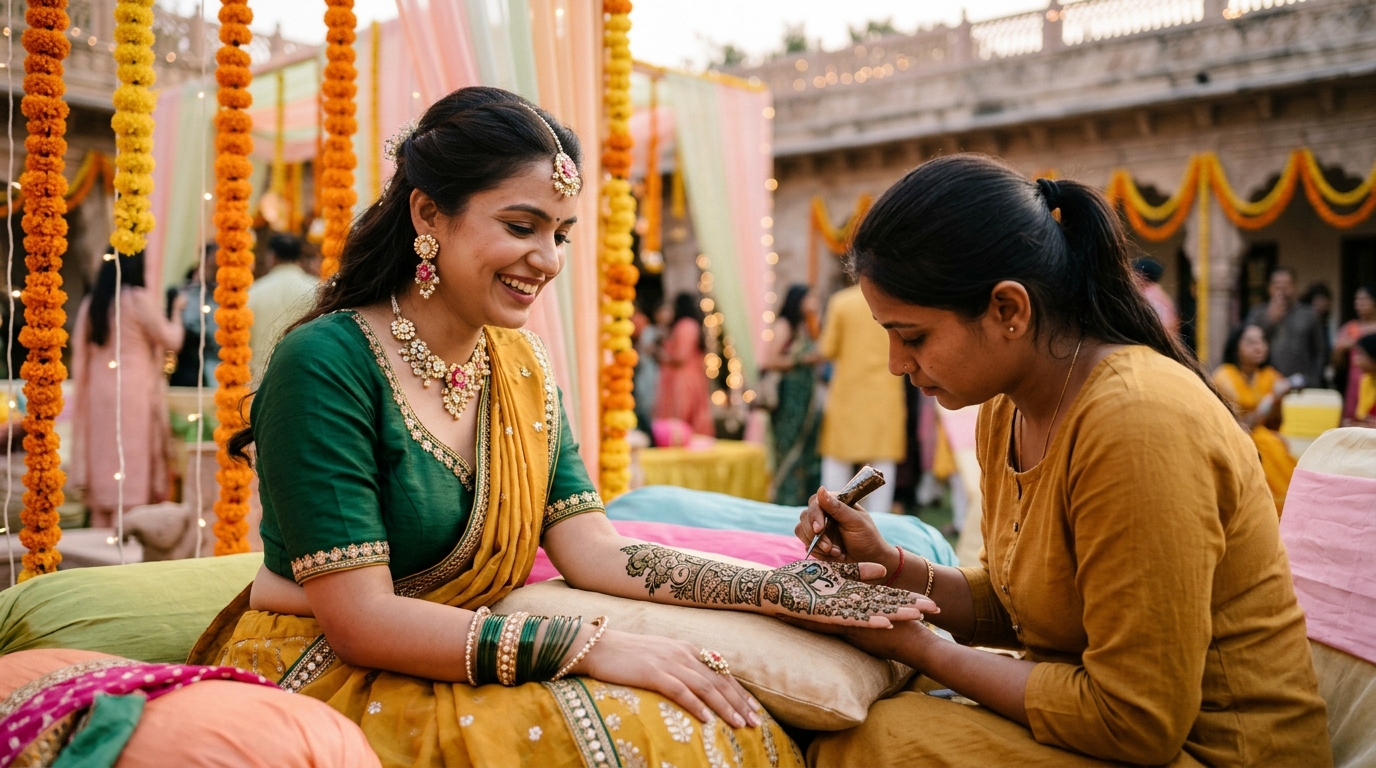
- Micro-Intricate Henna / Mehndi: Deep mahogany line work on both dorsal and palmar hand surfaces, requiring high micro-contrast and edge-to-edge optical sharpness without muddy skin rendering.
- Fine Chiffon & Organza Dupattas: Translucent sheer veils that demand delicate edge separation and backlighting to reveal subtle hand-embroidered border motifs without clipping highlights.
When you point an on-camera speedlight or rely on the bridal suite's mixed tungsten sconces, you encounter an exposure nightmare: either the bride’s face and lehenga are correctly exposed while her Polki jewelry blows out into solid white clipping, or the diamonds sparkle while the heavy velvet dress turns into an underexposed, muddy black mass. Solving this requires strict physical staging and controlled directional lighting.
💎 2. The Macro Jewelry Protocol: Lighting Kundan, Polki & Engagement Rings
To achieve magazine-grade macro clarity that high-end clients expect for their wedding albums and luxury vendors repost, you need deliberate macro optics and cross-polarized or diffused lighting techniques.
A. Focal Length & Lens Choice
Ditch close-up filter attachments and standard zoom lenses at 70mm with minimum focus distance limitations. The gold standard for bridal jewelry is a dedicated 1:1 reproduction macro lens:
- Sony FE 90mm f/2.8 Macro G OSS or Canon RF 100mm f/2.8L Macro IS USM: Offering true 1.0x (or 1.4x on Canon) magnification, internal stabilization, and flat-field optical designs that eliminate spherical aberrations on gemstone edges.
- Nikon NIKKOR Z MC 105mm f/2.8 VR S: Exceptional edge-to-edge micro-contrast that makes individual diamond pavé settings and uncut emerald facets jump off the screen.
B. Defeating Specular Glare: The Mini Softbox & Diffusion Tent
Jewelry does not look good when blasted with bare light. Polki and Kundan stones are mirrors. To illuminate them, you must show them a beautiful reflection:
- Large Diffusion Surface: Position a handheld 60cm collapsible octabox or a shoot-through diffusion panel mere inches away from the jewelry. Because apparent light source size increases as it gets closer, this produces silky, gradient reflections across gold bands rather than tiny hot spots.
- White Foam Core & Black Foil Flags: Use a simple 10x15cm white bounce card to fill the front of the necklace while placing a small black foil flag opposite the light source. The black flag introduces negative fill, giving deep, rich three-dimensional contrast to emerald and ruby stones.
👗 3. Exposing Dark Velvet Lehengas & Sabyasachi Ensembles
Deep wine, maroon, and emerald bridal lehengas present an extreme dynamic range challenge. The fabric absorbs light like a black hole, while the gold thread embroidery clips readily. Here is how luxury wedding photographers balance the dynamic range in-camera:
The Feathered Rim & Fill Light Setup
- Hanging the Outfit: Never leave the bridal lehenga draped sloppily over a wooden chair. Hang it from a customized wooden hanger hooked onto an architectural archway, antique wardrobe door, or floor-to-ceiling curtain rod with neutral backdrops.
- Key Light (45-Degree Soft Feather): Place your key strobe (Godox AD200 Pro or V1 Pro fitted with a 90cm parabolic softbox) at a 45-degree angle to the lehenga. Feather the light slightly in front of the garment so only the softer outer edge of the light beam grazes the heavy fabric. This illuminates the gold embroidery with rich directional texture without blowing out the highlights.
- Rim Light (Separation from Background): Place a bare speedlight with a grid or stripbox directly behind the garment at 1/64 power aimed toward the fabric edges. This creates a crisp, glowing silhouette rim that separates dark maroon velvet from dark hotel wallpapers.
- Expose to the Right (ETTR): Check your camera's RGB histogram. Push your exposure so the red channel hugs the right wall without climbing up it. Because digital sensors store significantly more shadow information in the upper exposure stops, pulling down highlights in post-production produces clean, noise-free velvet textures.
⏱️ 4. The 45-Minute Bridal Prep Timeline: Clockwork Execution
Bridal makeup almost always runs behind schedule. A professional studio team does not wait idly in the lobby; they execute the detail phase concurrently while the MUA completes the bride's hair and base makeup.
| Timeline Slot | Target Action & Composition | Gear & Lighting Setup |
|---|---|---|
| Minute 00 – 15 | Solo Flat Lay & Jewelry Macros (Necklace, Rings, Matha Patti, Bridal Shoes, Invitation Suite) | 90mm Macro @ f/8, Godox AD200 + 60cm Diffuser, Tabletop Mini Rig |
| Minute 15 – 25 | Full Lehenga Architecture Shot, Dupatta Draping Details & Hand Henna Close-ups | 35mm or 50mm f/1.4 Prime @ f/2.8, Feathered Key Softbox + Kicker Rim |
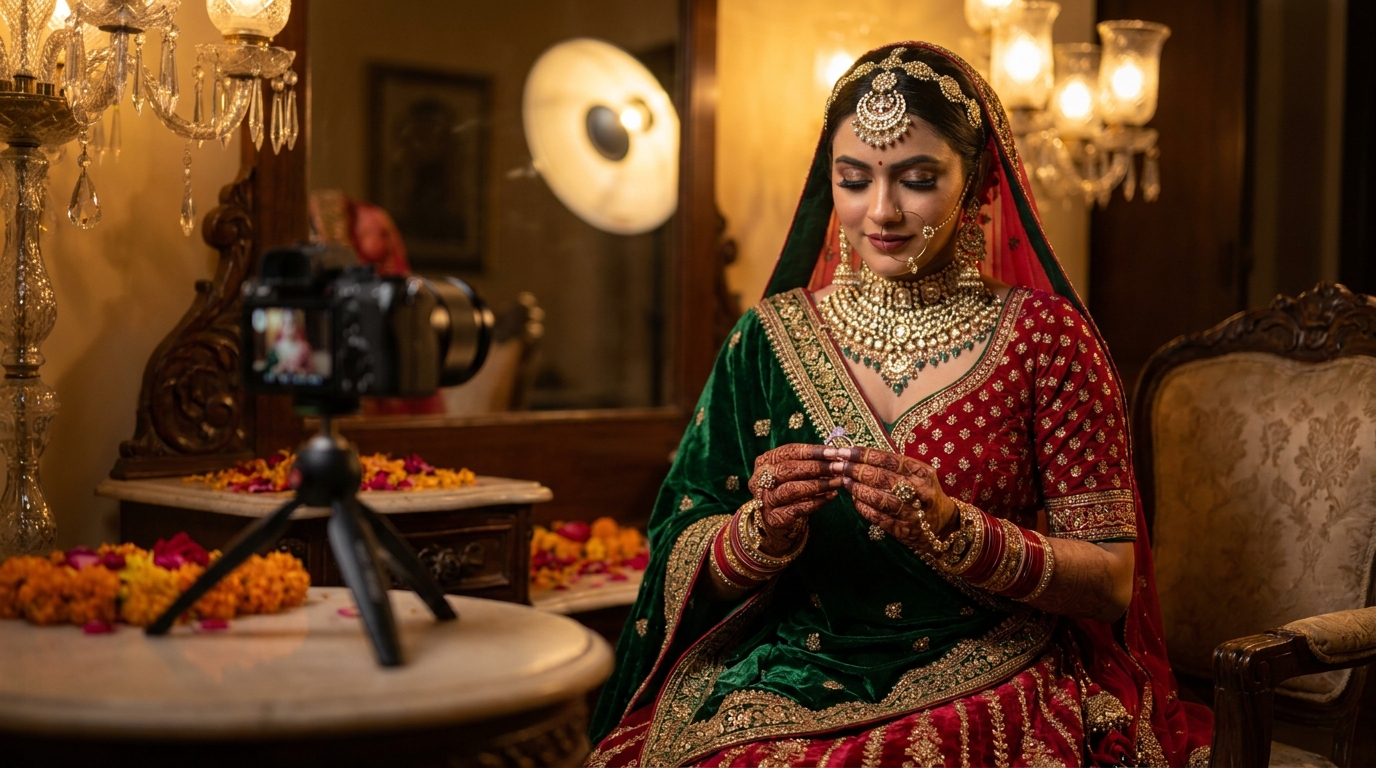
| Minute 25 – 35 | Finishing Touches: Lipstick Application, Eyelash Glance, Mother Fastening Choker | 85mm f/1.4 Prime @ f/2.0, Ambient Mirror Glow balanced with On-Camera Bounce Flash |
| Minute 35 – 45 | Grand Solo Bridal Portraits: Looking-Back Gaze, Dupatta Framing & Royal Standing Stance | 50mm / 85mm Prime @ f/2.2, 90cm Octabox Key Light + Natural Window Backlight |
⚡ 5. The Workflow Bottleneck: From 600 Bridal RAWs to Client-Approved Album Spreads
Shooting gorgeous bridal macro details is only half the battle. During a typical Indian wedding weekend, a studio crew captures over 4,000 to 8,000 high-resolution RAW files across three memory cards per camera. A single bridal prep session easily generates 600+ burst shots of micro-expressions, jewelry angles, and duplicate portraits.
Historically, wedding studios faced severe operational friction after returning to the studio:
- Endless Hard Drive Digging: Photographers manually scrolled through folders searching for the 25 ring and jewelry shots requested by the album designer.
- Weeks of Selection Delays: Exporting watermarked JPEGs, uploading cumbersome Google Drive folders, and waiting 4 months for the bride to send back a handwritten list of filenames like
_DSC8492.JPG. - Delayed Final Payments: With wedding album proofs stalled, the studio's final 20% to 30% milestone payment remains locked in limbo.
📋 6. The 4-Step Bridal Detail Action Checklist
Use this proven field checklist on your next wedding assignment to ensure flawless execution from the camera bag to the editing suite:
- 1️⃣ ✅ Establish the Staging Zone: Claim a clutter-free 6x6-foot corner near natural window light; turn off overhead yellow 3000K hotel ceiling bulbs to prevent mixed-color cross-contamination.
- 2️⃣ ✅ Deploy Dedicated Macro Optics: Lock your 90mm or 105mm macro at f/8 to f/11 with a tabletop stand; backlight uncut Polki stones with a feathered off-camera flash modifier.
- 3️⃣ ✅ Preserve Velvet Highlights via ETTR: Frame the full bridal lehenga, meter for the gold embroidery highlights, and apply a subtle grid-rim kicker behind the garment for crisp background separation.
- 4️⃣ ✅ Automate Proofing with Pixelect: Export a compressed web gallery within 24 hours, send the bride a 6-digit WhatsApp PIN access link, and use Pixelect's 1-Click Local RAW Auto-Copy tool to pull the final selected RAWs in 15 seconds flat.
❓ Frequently Asked Questions (FAQs)
Q1: How do I handle jewelry reflections showing my camera lens or flash softbox?
Polki and mirror Kundan jewelry act as curved mirrors. Angle your camera slightly off-axis (around 10 to 15 degrees) rather than shooting directly perpendicular to the flat stone surface. Additionally, drape a large white translucent shoot-through umbrella or diffusion sheet directly in front of your rig with a small cut-out hole just large enough for the front lens element.
Q2: What is the best camera profile setting for Indian skin tones during bridal prep?
In high-contrast vanity rooms with yellow mirror light bulbs, set your white balance manually to 4800K–5200K or use an X-Rite ColorChecker passport card. In Lightroom or Capture One, avoid high-contrast Adobe Standard profiles; instead, switch to Camera Portrait or Camera Neutral, and soften the orange luminance slider to preserve the bride’s natural golden undertones without oversaturating the heavy bridal makeup.
Q3: How does Pixelect's 1-Click Local RAW Auto-Copy solve the post-wedding headache?
When the bride finishes selecting her favorite 250 album photos on her custom Pixelect mobile gallery, she hits "Submit". Pixelect generates a lightweight selection manifest. With one click inside the Pixelect desktop companion or smart script, your computer scans your external hard drives and copies all 250 selected RAW files into a dedicated album folder in under 15 seconds—saving hours of tedious manual file searching.
🚀 Eliminate Photo Selection Delays & Supercharge Your Studio
Stop letting album selections sit unapproved for months. Give your couples a lightning-fast, high-converting WhatsApp PIN gallery and let Pixelect's 1-Click Local RAW Auto-Copy pull your selected RAWs in 15 seconds flat.
Try Pixelect Smart Selection Free →