Executive Summary
The Indian bridal entry under the Phoolon ki Chaadar (floral canopy) is arguably the single most emotionally charged, high-stakes 180 seconds of the entire wedding day. Between uneven floral canopy shadows, chaotic aisle crowds, blinding guest smartphones, and sudden cold pyro blasts, Indian wedding photographers face a minefield of technical hurdles with zero second chances. This masterclass reveals the exact lighting configurations, backward gimbal movement mechanics, multi-camera synchronization protocols, and rapid post-shoot culling workflows used by top luxury studios to capture magazine-cover frames and viral cinematic reels every single weekend.
🌸 The High-Stakes Geometry of the Phoolon Ki Chaadar: Why 80% of Entries Suffer
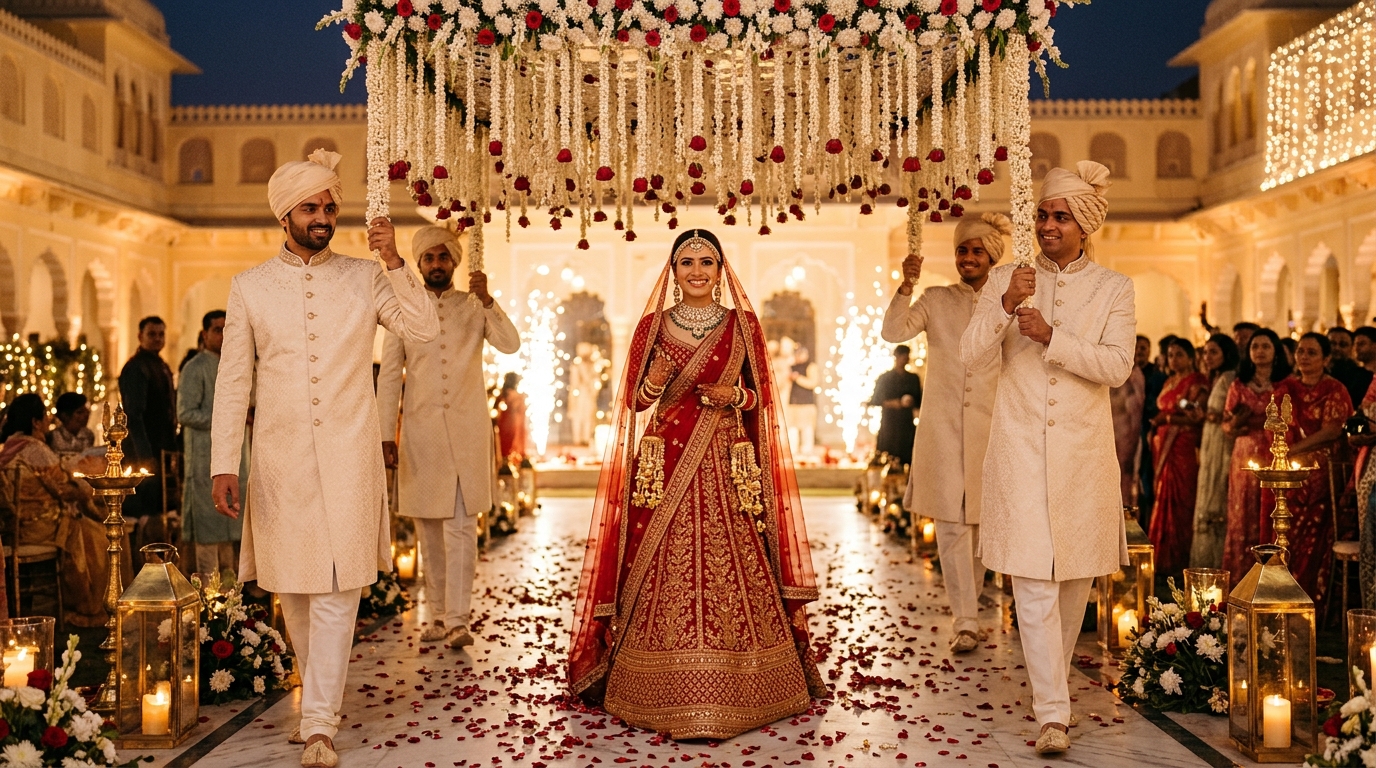
Every Indian wedding photographer knows the visceral adrenaline spike that occurs when the DJ switches the house track to "Din Shagna Da" or a bespoke acoustic bridal rendition. The heavy banquet doors swing open, relatives crane their necks, and the bride takes her first trembling steps down the aisle beneath an ornate canopy of cascading tuberoses, baby’s breath, and Dutch roses held aloft by her brothers.
Yet, when reviewing the raw footage on the editing monitor the next morning, heartbreaks happen with alarming regularity. The bride’s face is cast in murky green or yellow floral shadows; eager guests wielding bright smartphone flashes have ruined the background framing; the gimbal operator tripped over a lehenga trail; or the second shooter missed the groom’s tearful first-look reaction because an overzealous uncle stepped in front of the lens.
The core problem is rarely gear—it is spatial geometry and lack of disciplined crew choreography. The traditional Indian bridal walk spans roughly 30 to 60 meters and lasts between 90 and 180 seconds. In that fleeting window, your team must capture four distinct visual stories simultaneously:
- The Wide Environmental Master: Establishing the grand architectural grandeur of the aisle, the glowing floral canopy, and the expectant crowd.
- The Medium Emotional Bridal Solo: Isolating the bride’s micro-expressions, glowing jewelry, and sheer embroidered dupatta.
- The Dynamic Cinematic Tracking Shot: Silky-smooth backward gimbal footage moving in lockstep with her walking cadence.
- The Groom's Spontaneous Reaction: Capturing the raw, unposed emotion on the mandap stage at the exact moment she enters his line of sight.
To execute this without collision, professional studios enforce a strict 3-Tier Buffer Zone along the aisle before the bride takes a single step. The Lead Gimbal Operator maintains a rigid 2.5-meter forward buffer, walking backward; the Lead Stills Photographer operates on a 70-200mm telephoto lens from 6 to 8 meters ahead; and the Second Photographer is permanently anchored at the mandap stage, pre-focused on the groom.
💡 Lighting Under the Floral Canopy: Slaying Shadows Without Harsh Glare
The single greatest technical challenge of the Phoolon ki Chaadar is optical: the dense floral weave blocks overhead ambient hall lighting, creating an unflattering 2 to 3-stop exposure deficit directly on the bride's forehead, eyes, and cheekbones. If the banquet ceiling features warm 2700K halogen downlights or cold 6500K LED strips, the light filtering through green foliage casts sickly, desaturated skin tones across her intricate bridal makeup.
Amateur photographers instinctively mount an on-camera flash on the hotshoe and blast direct TTL light down the aisle. This is a fatal mistake: it produces harsh, clinical specular highlights on the bride’s nose and jewelry, casts a sharp, distracting black shadow of the floral poles onto the floor, and completely flattens the rich crimson, marigold, and gold textures of her zardozi lehenga.
Instead, elite wedding cinematographers and photographers deploy a Mobile Off-Axis Feathered Fill System:
- The Monopod-Mounted Micro Strobe / Wand: Assign an assistant to walk alongside the floral canopy—just outside the visual frame—carrying a lightweight monopod equipped with a Godox AD100 Pro or V1 with a magnetic dome diffuser, or a continuous bi-color LED tube (such as an Amaran T2c or Nanlite Pavotube).
- 45-Degree Feathered Elevation: The light is held at a 45-degree angle above the bride’s eye level, pointing slightly across her face rather than dead center. This fills the cavernous floral shadow with soft, creamy directional illumination while carving gentle cheekbone contours.
- Color Temperature Calibration: Match the fill light to the ambient aisle mood. If the venue is illuminated by warm fairy lights and brass candelabras, snap on a 1/2 CTO gel or set your continuous LED to 3200K. This eliminates the dreaded dual-color-cast that requires hours of nightmare brushwork in Lightroom.
During the pre-wedding client briefing, always request the wedding planner or brother holding the front of the canopy to pause for 5 full seconds at the halfway mark of the aisle. This intentional hesitation allows the bride to look up, breathe, and soak in the room while your team captures an immaculate, tack-sharp portrait with zero motion blur.
🎥 Cinematic Backward Gimbal Tracking: The "Velvet Walk" Footwork & Camera Settings
Capturing the bride walking towards you on a 3-axis motorized gimbal (such as the DJI RS 3 Pro or RS 4) produces sublime, cinematic footage that couples obsess over on Instagram Reels. However, walking backward down a crowded wedding aisle strewn with rose petals, electrical cables, and encroaching guests is fraught with disaster.
To eliminate vertical camera bounce and preserve razor-sharp autofocus, master the Velvet Walk protocol:
- The Physical Heel-to-Toe Stride: Never walk backward with straight legs. Keep your knees bent in an athletic half-squat, shifting weight softly from toe to heel. Your lower body acts as an organic secondary shock absorber, isolating the gimbal’s Z-axis from footstep jolts.
- The Human Spotter Anchor: Never walk backward solo down an Indian wedding aisle. Have your second assistant or production grip hold the back loop of your belt or backpack strap with one hand, physically clearing guest arms and warning you of floor steps or obstacles without interrupting your framing.
- Lens Selection & Sweet Spot Aperture: While shooting at f/1.2 or f/1.4 looks dreamy, the swaying floral fringes of the canopy and sheer bridal veil can easily trick modern AI autofocus systems into locking onto a hanging jasmine blossom instead of the bride’s pupil. Stop down to f/2.2 or f/2.8 on a 35mm prime or 24-70mm f/2.8 zoom. This delivers lush background separation while providing enough depth of field to guarantee her jewelry and eyes remain tack-sharp even as she moves.
- Frame Rates & Shutter Angle: Shoot in 4K 60fps at 1/120s shutter speed (or 50fps at 1/100s in 50Hz regions). This gives your editors the flexibility to slow the footage down to 40% in post-production, turning an ordinary 30-second walk into a breathtaking 75-second cinematic dream sequence set to high-tempo or soulful vocals.
Relying exclusively on full-auto Eye AF when the bride wears a heavily beaded matha patti (forehead ornament) and a sheer dupatta veil over her forehead. In low-light banquet halls, autofocus sensors frequently hunt between the sparkling polki gems and her actual eyes. Set your focus box to Flexible Spot: Small with Subject Detection priority set to Human Eye, and map a custom rear button to instantly toggle eye tracking if the sensor clings to the floral canopy.
💔 The Split-Second Groom First-Look: Synchronizing Multi-Camera Angles
The bridal entry is only 50% about the bride. The remaining 50% of the emotional weight lives entirely on the groom’s face as he stands atop the mandap, seeing his life partner in full bridal attire for the very first time. If your studio misses this moment, no amount of drone shots or slow-motion floral captures will compensate for the omission.
To capture this split-second reaction flawlessly, your lead still photographer or dedicated second shooter must execute the following positioning strategy:
- High-Compression Telephoto Optics: Mount an 85mm f/1.4 or 70-200mm f/2.8 on your stage body. Stand slightly offset from the center of the mandap stage, framing the groom from a tight three-quarter perspective. The optical compression will blur out distant banquet chandeliers and eliminate distracting stage decor, isolating his micro-expressions—the nervous swallow, the moist eyes, the uninhibited grin.
- Dual-Camera Timecode / Clock Sync: Prior to the wedding starting, ensure all cameras in the field have their internal clocks synchronized down to the exact second. When culling thousands of burst files in post-production, chronologically sorting the bride’s first step alongside the groom’s reaction creates effortless, tear-jerking split-screen reels and double-page album spreads.
- Silent Electronic Shutter: Switch your camera to electronic shutter mode or quiet continuous burst during the entrance. The sacred silence or soft acoustic shehnai playing should not be disrupted by machine-gun mechanical shutter clatter during such an intimate, tearful revelation.
The groom’s first-look reaction occurs within the first 10 seconds of the bride appearing in his sightline. Do not wait for her to arrive at the mandap steps. The moment the crowd turns their heads, your stage shooter must lock onto the groom's eyes and maintain continuous burst fire.
📊 Old Manual Studio Workflow vs. The Modern Pixelect Ecosystem
Capturing 800 high-speed continuous frames and 20GB of 4K 60fps footage during a 3-minute bridal entry is only half the battle. Delivering those signature moments to anxious couples without losing weeks to manual culling and hard drive chaos is what separates high-earning studios from struggling freelancers.
✅ 4-Step Pre-Entry Protocol: The Flawless Bridal Procession Checklist
Print this actionable 4-step checklist or save it to your lead shooter's smartphone before heading to the venue:
-
1️⃣
Aisle Clearance & Spotter Assignment:
✅ Physically inspect the walkway 15 minutes before entry. Clear floral debris, loose gaffer tape, and stage wire ramps. Assign a crew member as the dedicated backward spotter.
-
2️⃣
Canopy Light Balancing & CTO Gel Check:
✅ Fire a test shot beneath the assembled Phoolon ki Chaadar in the holding foyer. Verify skin tone kelvin (3200K–4500K) and adjust the mobile fill monopod power so highlights on the forehead don't clip.
-
3️⃣
Stage Shooter Position & Intercom Radio Check:
✅ Radio confirm with the stage shooter that the groom's sightline is 100% unobstructed. Verify that both camera bodies have identical internal clock timecodes for chronological sorting.
-
4️⃣
Rapid Selection Staging with Pixelect:
✅ Ingest the bridal entry burst into Pixelect Smart Selection immediately after the mandap rituals. Generate a mobile-friendly WhatsApp PIN gallery in minutes to deliver instant preview gratification to the couple.
❓ Frequently Asked Questions (FAQs)
Q1: How do you stop enthusiastic guests from stepping into the aisle with smartphones?
Coordinate with the wedding planner or banquet emcee to make a polite 30-second announcement 2 minutes before the bride enters: "Ladies and gentlemen, our bride is about to make her grand entrance. The couple kindly requests everyone to remain seated and keep aisles clear so our photography team can capture this once-in-a-lifetime moment without obstruction." Additionally, having two event coordinators stand at the aisle rope stanchions prevents eager guests from lunging forward.
Q2: What camera settings work best when cold pyro sparklers suddenly ignite along the walkway?
Cold pyro sparklers fire at approximately 1,800K to 2,200K and introduce an extreme 4-stop highlight surge. Switch your camera metering mode to Highlight-Weighted Metering (or underexpose by -1.0 to -1.3 EV manually). Because modern full-frame sensors (Sony A7 IV, Canon R6 II, Nikon Z8) possess massive 14+ stops of dynamic range, recovering deep shadows in post-production is effortless, whereas clipped blown-out whites on the bride’s face from sparkler glare cannot be restored.
Q3: How do top studios deliver the viral Bridal Entry Reel within 2 hours of the ceremony?
Top studios deploy an on-site video editor in the media room. As soon as the bridal entry concludes, the spotter grip runs the high-speed SD card to the editing desk. Using a pre-built Premiere or DaVinci timeline template loaded with trending audio, the editor cuts the 4K 60fps slow-mo clips, applies a custom Indian wedding LUT, and exports a 9:16 vertical reel. The reel is uploaded to the couple's branded Pixelect client gallery and shared directly via WhatsApp before dinner is served, driving immense word-of-mouth virality.
Stop Wasting Hours on Manual Wedding Photo Selection
Tired of endless client WhatsApp reminders, lost pen-drives, and manually typing 500 file names to extract RAW files? Upgrade your photography business with Pixelect Smart Selection.
- ✨ Instant WhatsApp PIN Galleries: Clients select their favorite photos on any phone.
- ⚡ 1-Click Local RAW Auto-Copy: Extract selected RAW files in 15 seconds flat.
- 🔒 Zero Selection Delays: Close wedding deliverables and collect balance payments 5x faster.