.png)
Flash isn't just for lighting up a dark room—it’s a creative tool for adding drama, depth, and a high-end editorial look to your wedding portfolio.
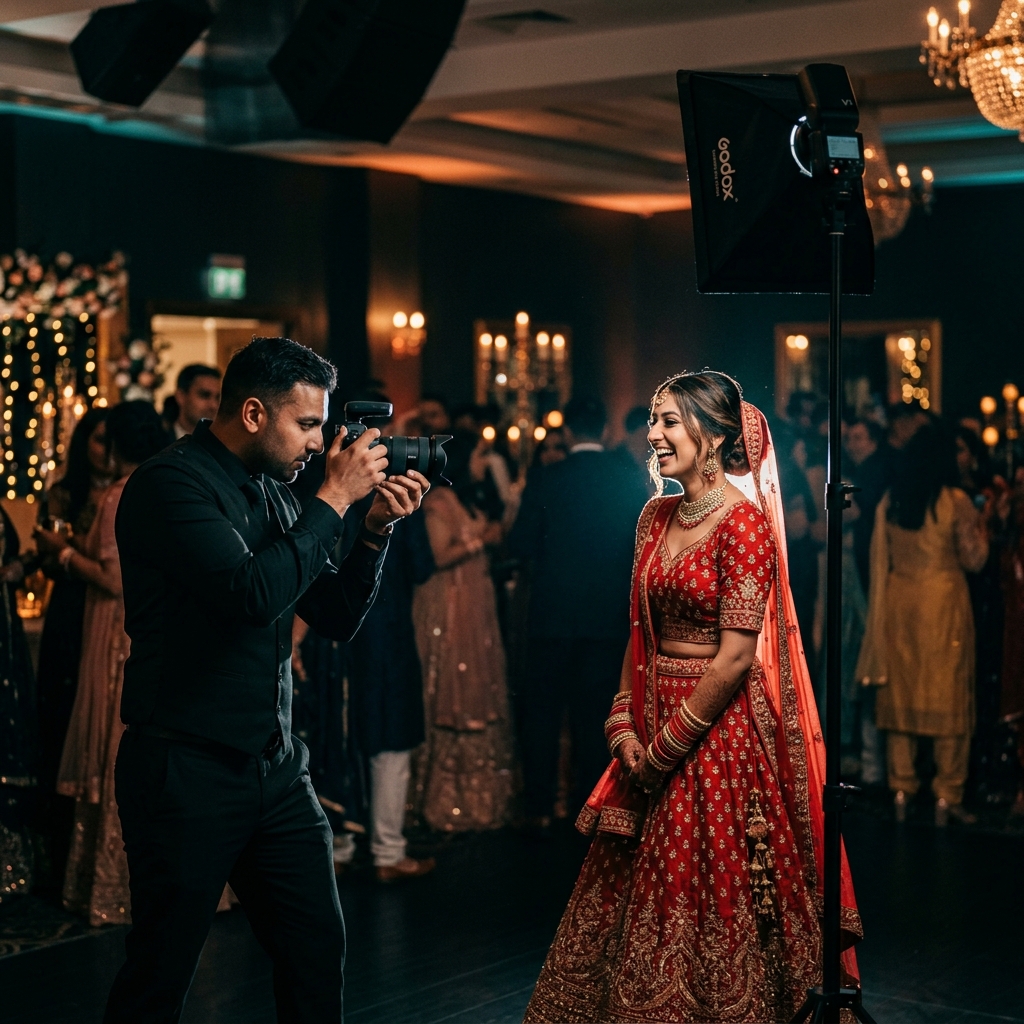
Whether it’s the chaotic dance floor at a Sangeet or the golden hour couple session, mastering flash will give you a consistent signature style regardless of the ambient lighting conditions. In this guide, we’ll explore techniques ranging from basic on-camera bounce to complex multi-light setups. ⚡
1. The Art of the Bounce
Most photographers start by pointing their flash directly at the subject, which creates harsh shadows and "flat" skin tones. The secret to soft, flattering light is bouncing.
- Ceiling Bounce: Angle your flash head upward at a 45° or 90° angle. This turns the entire ceiling into a massive softbox.
- Wall Bounce: If you want more "direction" to your light (like window light), point your flash slightly behind you and to the side toward a wall. The light will wrap around the subject more naturally.
"Tip: Be careful with colored walls. Bouncing off a green or blue wall will cast those colors directly onto your subjects' skin. Stick to white or neutral grey surfaces."
2. Off-Camera Flash (OCF) for Drama
Moving your light source away from the camera lens creates "dimension."
Backlighting for "Glow"
During a rainwater entry or a night time Baarat, place one flash directly behind the bride or groom. This creates a stunning rim light (hair light) that separates them from the dark background and makes them pop.
Side-Lighting for Mood
Place a flash at a 90° angle to your subject during bridal portraits. This highlights the textures in the jewelry and embroidery while letting the other side of the face fall into subtle shadow.
Focus on Lighting, Not Culling
Don’t let your masterpiece get lost in a sea of 6,000 photos. Let Pixelect’s AI workflow deliver only the best shots to your clients, instantly.
Get Started for Free3. The Sangeet Dance Floor: Shutter Dragging
If you want those dynamic, "party" shots with neon trails behind the dancers, you need to "drag the shutter."
- Set your camera to 1/15th or 1/30th of a second.
- Use an Aperture around f/4 or f/5.6.
- Turn on your flash (TTL or Manual).
- When you take the photo, wiggle your camera slightly. The flash will freeze the dancer's movement while the slow shutter speed captures the ambient DJ lights as colorful trails.
4. High-Speed Sync (HSS)
Have you ever tried to use flash in broad daylight only to find your shutter speed is limited to 1/200th? You need High-Speed Sync.
HSS allows you to shoot at 1/4000s or faster with flash. This is essential for outdoor daylight portraits where you want a shallow depth of field (f/1.8) while still using flash to fill in harsh shadows on the faces.
5. Gelling Your Flash
Indian weddings are often lit with warm yellow tungsten lights. Using a standard blue-ish "Daylight" flash can make your subjects look out of place. Use a **CTO (Color Temperature Orange) gel** on your flash to match the ambient room lighting. This makes the image feel warmer and more natural.
Conclusion
Flash is the most powerful tool in your kit for creating professional, consistent results. Start simple with on-camera bouncing, then graduate to OCF for creative drama. Practice these techniques before the wedding day so they become second nature during the high-pressure moments.