Executive Summary & Key Findings
Across Indian wedding photography studios, the longest post-production delay occurs during album layout proofing and revisions. The average client takes 4.8 months to finalize their 12×36 photobook design when proofs are sent via static PDFs or WhatsApp screenshots. This bottleneck traps ₹50,000 to ₹1,50,000 in unpaid album balances per wedding, congests high-speed studio storage, and exhausts designers. This masterclass outlines the 4-step digital proofing framework, communication scripts, and interactive flipbook architecture used by top studios to compress revision cycles down to under 48 hours, secure frictionless sign-offs, and collect 100% of final payments on schedule.
📖 The 6-Month Album Revision Nightmare: Why Indian Wedding Studios Bleed Cash After the Wedding
Every Indian wedding photographer knows the excitement of delivering a wedding highlight film or Instagram teaser within a week of the reception. Compliments flood in, and your team feels triumphant. But then comes the dreaded third phase: The Physical Photobook Album.
In the traditional Indian studio workflow, the photographer exports 30 to 45 double-spread layout sheets (typically 12×36 inches at 300 DPI) designed in Photoshop. Because there has historically been no unified client-proofing standard for physical photobooks in India, studios default to three broken distribution methods:
- The 400MB Multi-Page PDF: The studio exports a heavy PDF via Google Drive. The bride attempts to open it on her phone during her commute, but microscopic 12×36 spreads render unreadable. She closes the file, intending to review it over the weekend—a weekend that never arrives.
- The 35-Image WhatsApp Dump: The studio exports JPEG spreads into a family WhatsApp group. Within minutes, multiple relatives reply with conflicting voice notes: "On slide 14, replace chacha ji's picture," or "Why is my lehenga looking magenta on page 8?" The designer has no visual anchor for which photo belongs to which slot.
- The In-Studio Trapping: The studio insists the couple visit the office to review the design on an editor's monitor. Booking a 2-hour meeting takes months of schedule coordination. Once they arrive, extended family members debate crop angles for hours, paralyzing your staff.
While the album sits in revision limbo, your studio suffers compounding financial damage. Almost all Indian wedding contracts tie the final 20% to 30% payment to album delivery. If an album takes seven months to approve, your studio is effectively extending an interest-free ₹50,000 loan to the client. Furthermore, your workstations remain bloated with open master PSD projects and duplicate cache files that choke expensive storage drives.
🎯 The Psychology of Client Paralysis: Understanding the "Family Committee" Phenomenon
To fix the album revision bottleneck, studio owners must understand why Indian clients delay approvals. Unlike Western weddings—where the photobook is an intimate keepsake curated solely by the couple—an Indian wedding album is a permanent multi-generational historical document. It will be passed around during festivals, scrutinized by distant relatives, and preserved for decades as proof of family prestige.
Because of this cultural weight, Indian couples experience severe decision fatigue and fear of social criticism. When handed 40 double-spread sheets containing 250 photos, the couple fears they inadvertently excluded an influential relative, allocated too much space to friends, or approved an unflattering expression. When given an open-ended request like "Please review and let us know your changes," human psychology defaults to procrastination.
Leading studios eliminate this inertia by shifting the dynamic from an open-ended negotiation to a structured editorial presentation. You are the visual director of their wedding legacy, not a print-shop operator awaiting instructions. When you present layouts through an elegant, interactive interface with clear visual hierarchy and strict micro-deadlines, the client feels guided, secure, and motivated to complete their review.
🚀 The 4-Pillar Fast-Track Album Approval Architecture
To consistently secure album sign-offs within 48 to 72 hours, high-volume Indian studios implement a standardized four-pillar digital proofing protocol:
Pillar 1: The Interactive 3D Digital Flipbook Experience
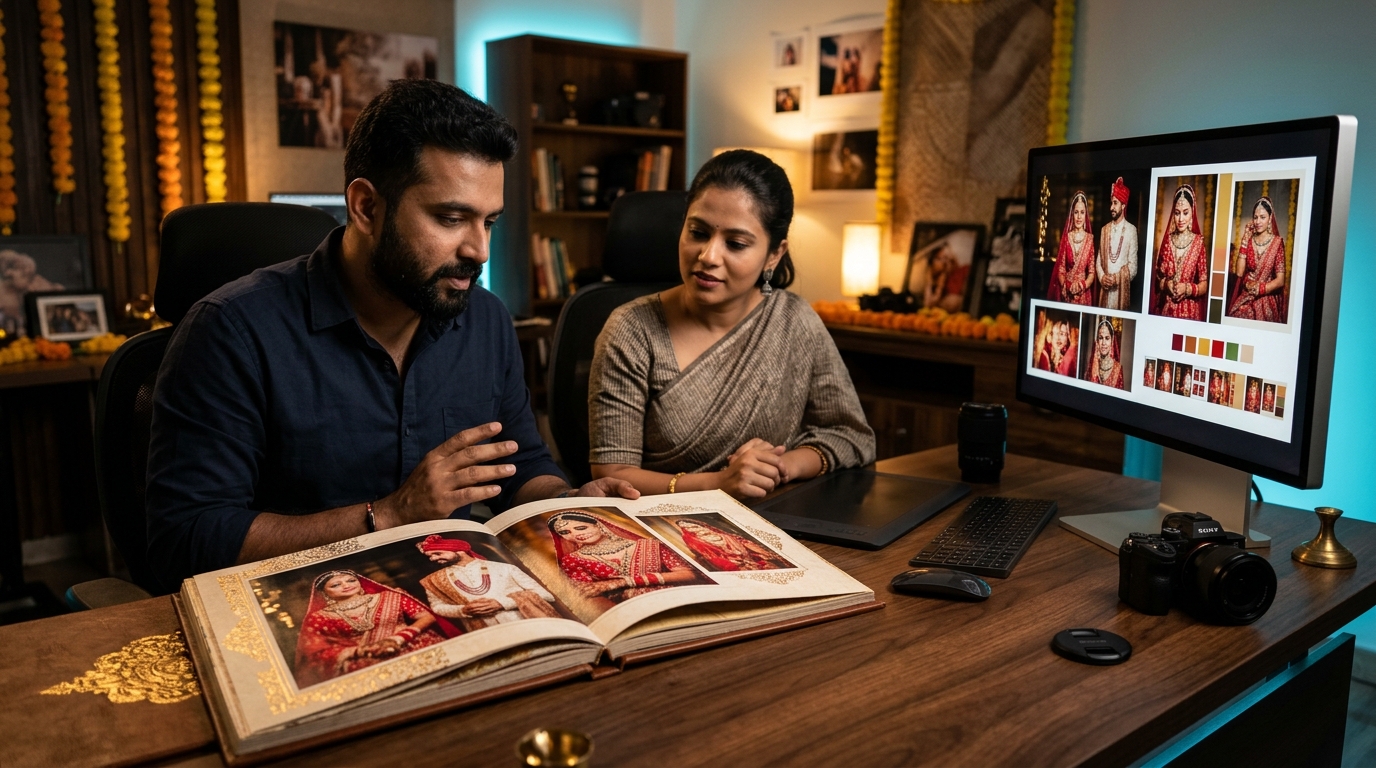
Modern clients live on smartphones. When you present your 12×36 album spreads in an interactive 3D digital flipbook that mimics the tactile experience of turning a physical velvet-bound photobook, perceived value skyrockets. Clients can pinch to zoom into high-resolution details on mobile screens, view authentic page-turn physics, and visualize how the spreads balance across the center fold. Instead of reviewing a flat technical proof, they preview their finished luxury heirloom.
Pillar 2: Direct Visual Pin-Point Annotation (Zero Voice Notes)
The greatest drain on an album designer's sanity is deciphering vague instructions like "Change the groom's photo on the right side of the haldi page." If the spread has six photos, the designer must guess which one the client meant. In a modern proofing workflow, the client taps the exact photo on the interactive spread and types their request directly onto the canvas: "Swap this photo with DSC_4821." Both parties see the exact coordinate pin, eliminating misunderstanding.
Pillar 3: The 2-Round Structured Revision Policy
Endless revisions are the result of poor contract boundaries. High-performing studios institute a crystal-clear revision framework outlined in the initial booking contract:
- Round 1 (Comprehensive Swaps): The client has 7 days from proof delivery to review the book and request up to 10 photo replacements or crop adjustments. All family members must consolidate their feedback into this single round.
- Round 2 (Final Verification): The designer executes Round 1 adjustments within 48 hours and re-submits the updated digital flipbook. The client has 48 hours to verify and click the digital "Approve for Print" button.
- Round 3+ (Paid Billable Scope): Any layout redesign or photo swapping requested after Round 2 incurs a transparent charge of ₹350 to ₹500 per spread to compensate the designer's time.
Pillar 4: Automated WhatsApp Notification & Micro-Commitment Triggers
Email notifications get lost in spam folders. When an album proof is ready, top studios trigger an automated WhatsApp message to the couple containing their private PIN, a 60-second video walkthrough on how to review spreads on mobile, and a clear timer highlighting when the print slot is scheduled at the lab.
⚖️ Workflow Breakdown: Traditional PDF Proofing vs. Modern Interactive Proofing
The operational divide between studios using antiquated manual methods and those utilizing modern automated proofing ecosystems is stark. The table below illustrates the real-world impact across studio turnaround time, labor costs, and financial liquidity.
📋 The 4-Step Actionable Album Proofing Implementation Checklist
Ready to overhaul your studio's album approval system before the upcoming peak wedding season? Execute this step-by-step checklist on your next three wedding deliveries:
Ditch cluttered 15-photo collage layouts. Adopt a clean, editorial layout philosophy: 3 to 5 images per double-spread for ceremony rituals (Sindoor Daan, Saat Phere) and full-bleed double-page hero shots for the Bridal Entry and Couple Portraits. Less clutter translates directly to fewer revision requests.
Never send raw PDF attachments. Upload your rendered 12×36 sheets into an interactive digital gallery or flipbook platform. Send the couple an automated WhatsApp message with their unique security PIN, congratulating them on the design completion and outlining their exact 48-hour review window.
Instruct the couple that all revisions must be submitted directly through the online proofing portal by tapping the specific image and entering the replacement file name. Strictly prohibit verbal voice notes or fragmented family chats to maintain a bulletproof change log.
Configure your client workflow so that when the client clicks "Approve Album for Printing," the system automatically presents the final balance invoice. Reiterate your studio policy: "Once approved, your bespoke leather album is queued for high-precision printing at our lab upon receipt of final milestone clearance."
❓ Frequently Asked Questions (FAQs) for Wedding Studio Owners
Q1: What if the client's family insists on having 8 or 10 family members review the album?
Anticipate this dynamic during your pre-wedding onboarding consultation. Establish that while family input is deeply cherished, the studio requires one designated Primary Point of Contact (POC)—usually the bride or groom—who is responsible for collecting family desires and submitting consolidated feedback. Giving eight relatives edit access guarantees contradictory demands. One POC keeps accountability crystal clear.
Q2: How do we handle clients who go completely silent for months after receiving the proof?
Include an automated "Dormant Project Policy" clause in your client agreement. If no feedback is submitted within 30 days of proof delivery despite automated WhatsApp reminders, the project is categorized as "Client On-Hold." Resuming the project after 60 days requires a nominal ₹2,500 archive retrieval fee to re-stage the project files. When clients know that delay carries an actual administrative cost, their responsiveness improves dramatically.
Q3: How can we connect client photo selections directly to our album layout without manual searching?
Manual search across 20,000 raw files is the primary cause of designer burnout. Modern studios use Pixelect SmartSelection to let clients select their 250 album favorites directly on mobile via secure PIN galleries. Once the client locks their selection, the studio downloads the lightweight `.pixelect` selection manifest and runs the 1-Click Local RAW Auto-Copy runner. In less than 15 seconds, all 250 high-resolution RAW files are automatically extracted from your local multi-terabyte drives into a dedicated `Album_Raw_Selected/` folder, ready for immediate layout design.
Transform Your Wedding Studio Into a High-Speed, Automated Powerhouse
Stop wasting 15+ hours hunting through 50,000 unorganized RAW files and chasing clients for photo selections. Join thousands of high-performing Indian wedding photographers who use Pixelect SmartSelection to deliver instant WhatsApp PIN galleries, eliminate client selection paralysis, and auto-copy selected RAW files locally in 15 seconds.
⚡ Supercharge Your Studio Workflow with Pixelect SmartSelection →